


Decano 23 SC
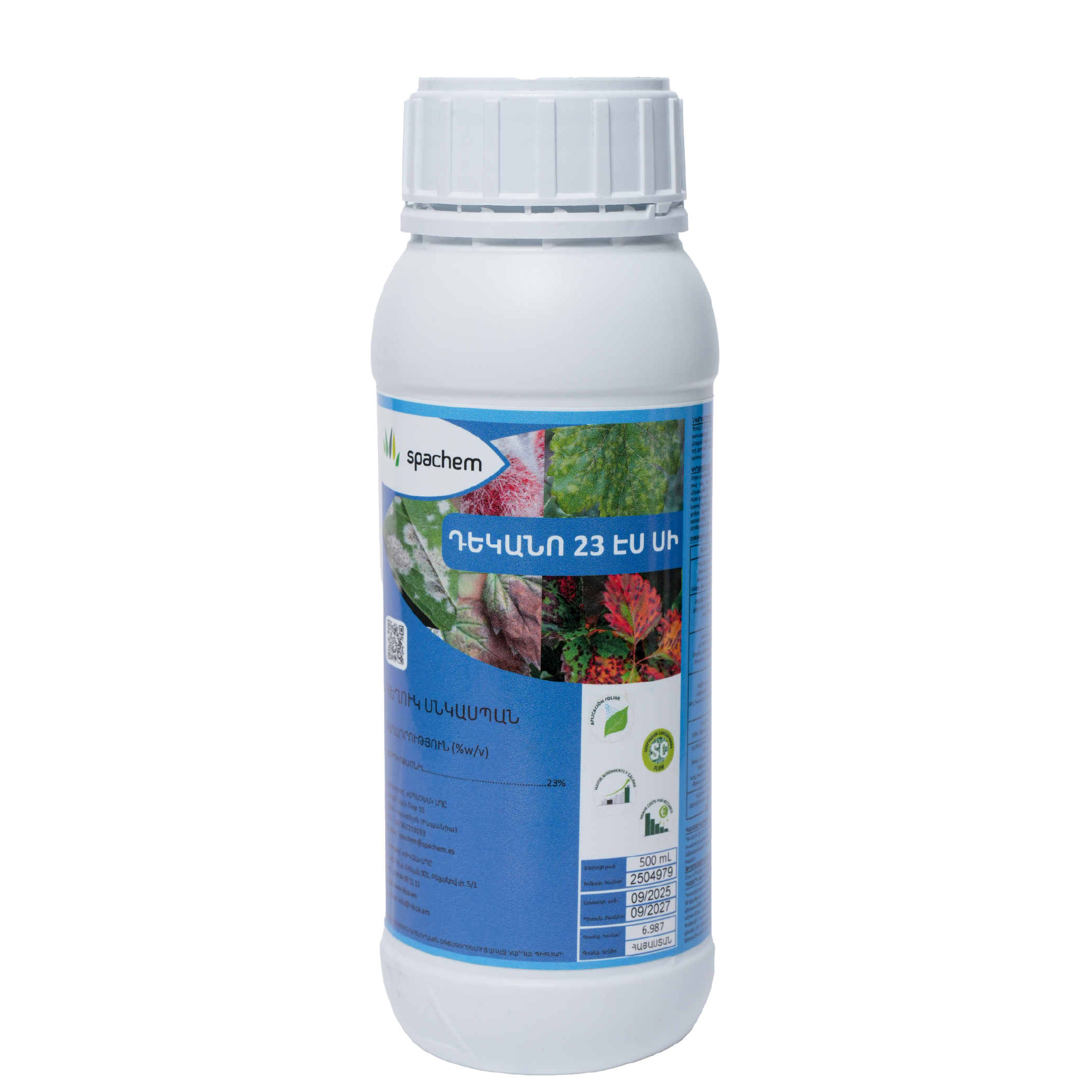
100ml, 250ml, 500ml, 1L, 5L, 10L, 20L, 200L, 1000L




DECANO 23 SC is a broad-spectrum fungicide in the form of a concentrated suspension (SC) authorized for post-harvest treatment and foliar applications just before harvesting on different crops.
Use the highest doses when the fruit to be treated has wounds, a high degree of pathogen infection or has been harvested under conditions of frequent rain.
| CROPS | PLAGUE | DOSE (L/Ha) |
|---|---|---|
| Fruit trees (peach, nectarine, plum, cherry, apricot, kumquat, pear, apple, pomegranate, persimmon, fig etc.) | Rot (Alternaria spp) |
0.2 - 0.4 |
| Fruit trees (peach, nectarine, plum, cherry, apricot, kumquat, pear, apple, pomegranate, persimmon, fig etc.) | Gray rot of stone fruits (Monilia cinerea) |
0.2 - 0.4 Flowering stage |
| Fruit trees (peach, nectarine, plum, cherry, apricot, kumquat, pear, apple, pomegranate, persimmon, fig etc.) | Fruit rot (Monilia fructigena) |
0.2 - 0.4 Flowering and pre-harvest stage |
| Fruit trees (peach, nectarine, plum, cherry, apricot, kumquat, pear, apple, pomegranate, persimmon, fig etc.) | Black cancer (Sphaeropsis malorum) |
0.5 - 0.7 |
| Fruit trees (peach, nectarine, plum, cherry, apricot, kumquat, pear, apple, pomegranate, persimmon, fig etc.) | Apple scab (Venturia inaequalis) |
1 - 1.5 |
| Fruit trees (peach, nectarine, plum, cherry, apricot, kumquat, pear, apple, pomegranate, persimmon, fig etc.) | Pear scab (Venturia pyrina) |
1 - 1.5 |
| Fruit trees (peach, nectarine, plum, cherry, apricot, kumquat, pear, apple, pomegranate, persimmon, fig etc.) | Grey mould (Botrytis spp) |
0.2 - 0.4 |
| Fruit trees (peach, nectarine, plum, cherry, apricot, kumquat, pear, apple, pomegranate, persimmon, fig etc.) | Root rot (Fusarium avenaceum) |
0.2 l/100 kg of seeds |
| Fruit trees (peach, nectarine, plum, cherry, apricot, kumquat, pear, apple, pomegranate, persimmon, fig etc.) | Root rot (Fusarium graminearum) |
0.2 l/100 kg of seeds |
| Fruit trees (peach, nectarine, plum, cherry, apricot, kumquat, pear, apple, pomegranate, persimmon, fig etc.) | Mold (Penicillium spp) |
0.2 - 0.4 |
| Fruit trees (peach, nectarine, plum, cherry, apricot, kumquat, pear, apple, pomegranate, persimmon, fig etc.) | Mold (Penicillium spp) |
0.2 - 0.4 |
| Fruit trees (peach, nectarine, plum, cherry, apricot, kumquat, pear, apple, pomegranate, persimmon, fig etc.) | Gray mold of grapes (Botrytis cinerea) |
0.2 - 0.4 |
| Fruit trees (peach, nectarine, plum, cherry, apricot, kumquat, pear, apple, pomegranate, persimmon, fig etc.) | Moniliosis (Monilinia spp) |
0.2 - 0.4 |
| Fruit trees (peach, nectarine, plum, cherry, apricot, kumquat, pear, apple, pomegranate, persimmon, fig etc.) | Rot (Rhizopus spp) |
0.2 - 0.4 |
| Fruit trees (peach, nectarine, plum, cherry, apricot, kumquat, pear, apple, pomegranate, persimmon, fig etc.) | Faba bean fusarium wilt (Fusarium oxysporum) |
0.5 - 0.7 |
| Vegetables (tomato, pepper, chili, eggplant, potato, carrot, zucchini) | Carrot black rot (Alternaria radicina) |
0.5 - 0.75 |
| Vegetables (tomato, pepper, chili, eggplant, potato, carrot, zucchini) | Cabbage root wilt (Fusarium oxysporum var. orthoceras Bil) |
0.5 - 0.7 |
| Vegetables (tomato, pepper, chili, eggplant, potato, carrot, zucchini) | Potato rot or fusarium (Fusarium solani) |
0.5 - 0.7 |
| Vegetables (tomato, pepper, chili, eggplant, potato, carrot, zucchini) | Macrosporiosis (Macrosporium solani (Alternaria solani)) |
0.5 - 0.7 |
| Vegetables (tomato, pepper, chili, eggplant, potato, carrot, zucchini) | Black scurf or rhizoctonia (Rhizoctonia solani) |
0.5 - 0.7 |
| Vegetables (tomato, pepper, chili, eggplant, potato, carrot, zucchini) | Tomato Septoria (Septoria lycopersici) |
0.5 - 0.6 |
| Vegetables (tomato, pepper, chili, eggplant, potato, carrot, zucchini) | Cabbage root wilt (Fusarium oxysporum var. orthoceras Bil) |
0.2 l/100 kg of seeds |
| Vegetables (tomato, pepper, chili, eggplant, potato, carrot, zucchini) | Root rot (Fusarium avenaceum) |
0.2 l/100 kg of seeds |
| Vegetables (tomato, pepper, chili, eggplant, potato, carrot, zucchini) | Root rot (Fusarium graminearum) |
0.2 l/100 kg of seeds |
| Vegetables (tomato, pepper, chili, eggplant, potato, carrot, zucchini) | Root rot of sprouts (Pythium debaryanum) |
0.5 - 0.7 |
| Vegetables (tomato, pepper, chili, eggplant, potato, carrot, zucchini) | Faba bean fusarium wilt (Fusarium oxysporum) |
0.5 - 0.7 Soil injection |
| Edible leaf crops (cabbage, lettuce, broccoli, spinach) | Root rot (Fusarium avenaceum) |
0.2 l/100 kg of seeds |
| Edible leaf crops (cabbage, lettuce, broccoli, spinach) | Root rot (Fusarium graminearum) |
0.2 l/100 kg of seeds |
| Edible leaf crops (cabbage, lettuce, broccoli, spinach) | Cabbage root wilt (Fusarium oxysporum var. orthoceras Bil) |
0.5 - 0.7 |
| Edible leaf crops (cabbage, lettuce, broccoli, spinach) | Cabbage root wilt (Fusarium oxysporum var. orthoceras Bil) |
0.5 - 0.7 |
| Edible leaf crops (cabbage, lettuce, broccoli, spinach) | Cabbage root wilt (Fusarium oxysporum var. orthoceras Bil) |
0.2 l/100 kg of seeds |
| Edible leaf crops (cabbage, lettuce, broccoli, spinach) | Potato rot or fusarium (Fusarium solani) |
0.5 - 0.7 |
| Edible leaf crops (cabbage, lettuce, broccoli, spinach) | Black leg of cabbage seedlings (Opidium brassicae) |
0.5 - 0.7 Soil injection |
| Edible leaf crops (cabbage, lettuce, broccoli, spinach) | Faba bean fusarium wilt (Fusarium oxysporum) |
0.5 - 0.7 |
| Liliaceas and other crucifera (garlic, onion, asparagus, turnip, radishes) | Root rot (Fusarium avenaceum) |
0.2 l/100 kg of seeds |
| Liliaceas and other crucifera (garlic, onion, asparagus, turnip, radishes) | Root rot (Fusarium graminearum) |
0.2 l/100 kg of seeds |
| Liliaceas and other crucifera (garlic, onion, asparagus, turnip, radishes) | Black leg of cabbage seedlings (Opidium brassicae) |
0.5 - 0.7 Soil injection |
| Liliaceas and other crucifera (garlic, onion, asparagus, turnip, radishes) | Faba bean fusarium wilt (Fusarium oxysporum) |
0.5 - 0.7 |
| Extensive and industrial (wheat, corn, barley, tabaci, beet) | Snow mold (Fusarium nivale) |
0.2 l/100 kg of seeds |
| Extensive and industrial (wheat, corn, barley, tabaci, beet) | Helminthosporium/ (Stripe rust) (Helminthosporium gramineum) |
0.2 l/100 kg of seeds |
| Extensive and industrial (wheat, corn, barley, tabaci, beet) | Helminthosporium leaf blight (Helminthosporium sativum) |
0.2 l/100 kg of seeds |
| Extensive and industrial (wheat, corn, barley, tabaci, beet) | Cotton rot (Rhizoctonia Aderholdii Kolosch) |
0.5 - 0.7 |
| Extensive and industrial (wheat, corn, barley, tabaci, beet) | Black scurf or rhizoctonia (Rhizoctonia solani) |
0.5 - 0.7 |
| Extensive and industrial (wheat, corn, barley, tabaci, beet) | Gray ear rot of maize (Rhizopus maydis) |
0.2 - 0.4 |
| Extensive and industrial (wheat, corn, barley, tabaci, beet) | Root rot (Helminthosporium teres) |
0.2 l/100 kg of seeds |
| Extensive and industrial (wheat, corn, barley, tabaci, beet) | Root rot (Fusarium avenaceum) |
0.2 l/100 kg of seeds |
| Extensive and industrial (wheat, corn, barley, tabaci, beet) | Root rot (Fusarium graminearum) |
0.2 l/100 kg of seeds |
| Extensive and industrial (wheat, corn, barley, tabaci, beet) | Root rot of sprouts (Pythium debaryanum) |
0.5 - 0.7 |
| Extensive and industrial (wheat, corn, barley, tabaci, beet) | Faba bean fusarium wilt (Fusarium oxysporum) |
0.5 - 0.7 |
| Berries (strawberry, raspberry, blueberry, blackberries, currant, vine) | Gray mold of grapes (Botrytis cinerea) |
0.3 - 0.5 Preventive |
| Berries (strawberry, raspberry, blueberry, blackberries, currant, vine) | Anthracnose of currant (Gloesporium ribis) |
0.5 - 0.75 |
| Berries (strawberry, raspberry, blueberry, blackberries, currant, vine) | Black rot of blackberries (Rhizopus nigricans) |
0.3 - 0.5 Post-harvest processing |
| Berries (strawberry, raspberry, blueberry, blackberries, currant, vine) | Powdery mildew of strawberry (Sphaerotheca macularis f. fragariae) |
0.5 - 0.75 Post-harvest processing |
| Berries (strawberry, raspberry, blueberry, blackberries, currant, vine) | Root rot (Fusarium avenaceum) |
0.2 l/100 kg of seeds |
| Berries (strawberry, raspberry, blueberry, blackberries, currant, vine) | Root rot (Fusarium graminearum) |
0.2 l/100 kg of seeds |
| Berries (strawberry, raspberry, blueberry, blackberries, currant, vine) | Gray mold of grapes (Botrytis cinerea) |
0.3 - 0.5 |
| Berries (strawberry, raspberry, blueberry, blackberries, currant, vine) | Rot (Rhizopus spp) |
0.3 - 0.5 |
| Berries (strawberry, raspberry, blueberry, blackberries, currant, vine) | Mold, spot (Cladosporium spp) |
0.3 - 0.5 |
| Berries (strawberry, raspberry, blueberry, blackberries, currant, vine) | Faba bean fusarium wilt (Fusarium oxysporum) |
0.5 - 0.7 |
| Cucurbitaceas (melon, watermelon, pumpkin) | Anthracnose of cucurbits (Colletotrichum lagenarium) |
0.5 - 0.7 |
| Cucurbitaceas (melon, watermelon, pumpkin) | Root rot (Fusarium avenaceum) |
0.2 l/100 kg of seeds |
| Cucurbitaceas (melon, watermelon, pumpkin) | Root rot (Fusarium graminearum) |
0.2 l/100 kg of seeds |
| Cucurbitaceas (melon, watermelon, pumpkin) | Faba bean fusarium wilt (Fusarium oxysporum) |
0.5 - 0.7 |
| Aromatic and ornamental (cilantro, parsley, mint, sage, rosemary, thyme, tarragon, rose, gerberas, thuja, fir tree, carnations) | Rot (Alternaria spp) |
0.3 - 0.6 |
| Aromatic and ornamental (cilantro, parsley, mint, sage, rosemary, thyme, tarragon, rose, gerberas, thuja, fir tree, carnations) | Root rot (Fusarium avenaceum) |
0.2 l/100 kg of seeds |
| Aromatic and ornamental (cilantro, parsley, mint, sage, rosemary, thyme, tarragon, rose, gerberas, thuja, fir tree, carnations) | Root rot (Fusarium graminearum) |
0.2 l/100 kg of seeds |
| Aromatic and ornamental (cilantro, parsley, mint, sage, rosemary, thyme, tarragon, rose, gerberas, thuja, fir tree, carnations) | Grey mould (Botrytis spp) |
0.3 - 0.6 |
| Aromatic and ornamental (cilantro, parsley, mint, sage, rosemary, thyme, tarragon, rose, gerberas, thuja, fir tree, carnations) | Fusarium |
0.3 - 0.6 |
| Aromatic and ornamental (cilantro, parsley, mint, sage, rosemary, thyme, tarragon, rose, gerberas, thuja, fir tree, carnations) | Faba bean fusarium wilt (Fusarium oxysporum) |
0.5 - 0.7 |
| Legumes (beans, peas, lentils) | Bean anthracnose (Colletotrichum lindemuthianum) |
0.5 - 0.7 |
| Legumes (beans, peas, lentils) | Root rot (Fusarium avenaceum) |
0.2 l/100 kg of seeds |
| Legumes (beans, peas, lentils) | Root rot (Fusarium graminearum) |
0.2 l/100 kg of seeds |
| Legumes (beans, peas, lentils) | Faba bean fusarium wilt (Fusarium oxysporum) |
0.5 - 0.7 |
Decano 23 SC
DECANO 23 SC is a broad-spectrum fungicide in the form of a concentrated suspension (SC) authorized for post-harvest treatment and foliar applications just before harvesting on different crops.
- FLUDIOXONIL 23.0 %
FLUDIOXONIL is a contact fungicide, broad spectrum and residual action, which acts by interfering with the osmotic regulation process of fungal cell membranes, causing cell rupture.
The main applications of DECANO 23 SC (fludioxonil 23%) are aimed at controlling post-harvest and pre-harvest field fungal diseases to avoid rotting during storage, conservation and transportation in crops such as potatoes, cherries, peaches, lemons, mandarins, apple, orange, pear, grapefruit, rose.
INTERVAL BETWEEN LAST APPLICATION AND HARVEST (WAITING PERIOD)
FIELD: 8h, Indoor: 24H
MAXIMUM NUMBER OF TREATMENTS
1 application.
Regulate the pH.
The effectivenes of treatments are provided by a complete follage wettiness and use of adjuvant.
TIME OF EMPLOYMENTIt is a product with preventive and residual activity that acts on the osmotic regulation of fungal spores with activity on sporulation.
It can be used for applications with the immersion, drench or spraying method on the classification line at the recommended doses or foliar spraying, always ensuring uniform wetting of the treated fruit.
In all cases it is advisable to work with clean fruit and ensure contact of approximately 30 seconds between the fruit and the broth with fungicide. To avoid the accumulation of inoculum in the postharvest lines and the possible inactivation of the fungicide, change the broth used after the planned amount of fruit has been treated instead of continuing to add formula to the preexisting broth.
It can also be used in foliar treatments prior to fruit harvesting and storage, as well as for seed treatment.
DECANO 23 SC is compatible with DPA (diphenylamine) and chlorine. Before using in a mixture with other products, a small-scale test must be carried out to evaluate the physical and biological compatibility of the components and the possible phytotoxicity for crops.
It is not phytotoxic when used according to the recommendations and doses of SPACHEM S.L. In case of mixing, perform a small scale test to check compatibility and phytotoxicity.
REMARKS
The recommendations and information we provide are the result of extensive and rigorous studies and tests, however, numerous factors beyond our control may intervene in the use (preparation of mixtures, application, weather, etc.). The company guarantees the composition, formulation and content. The user will be liable for any damage caused ( lack of efficacy, general toxicity, residues, etc.) due to total or partial non-observance of the label instructions.
- Verify the correct calibration of the equipment before starting the application
- Put water halfway up the tank of the applicator equipment, add the necessary amount of DECANO 23 SC product according to the dose recommended on this label, keeping the shaker running and top up with the rest of the volume of water.
- It is recommended to add a non-ionic adjuvant to improve coverage.
- Before starting any treatment, it is essential to verify the correct calibration of the equipment and the proper functioning of the nozzles (filters and pads), replacing the defective parts.
- Do not perform applications with high temperatures.
- Apply away from springs, courses, or fountains.
- Always calibrate your equipment with water only before applying the product.
- Remember to get the right auxiliary equipment (solid and liquid product meters), graduated trays, stirring paddles, brushes, brushes, etc.
- Use the following protective equipment for mixing, loading, and applying: boots, mask, goggles, gloves, and dispenser.
The icon refers to a suspension concentrate (SC). This is a liquid formulation containing a solid, insoluble active ingredient dispersed in water as very fine particles less than 10 microns. It is diluted in water for application, offering advantages such as easy handling, reduced dust, high efficacy, and good dispersion in water.
The icon communicates that the product is formulated to maximize productivity and improve the commercial quality of the crop.
The icon highlights fertilizers with high agronomic and economic efficiency.
The icon identifies products designed for direct application to leaves, where nutrients and biostimulants are rapidly absorbed through the stomatal and cuticular pathways.