


Demolish 25 EC
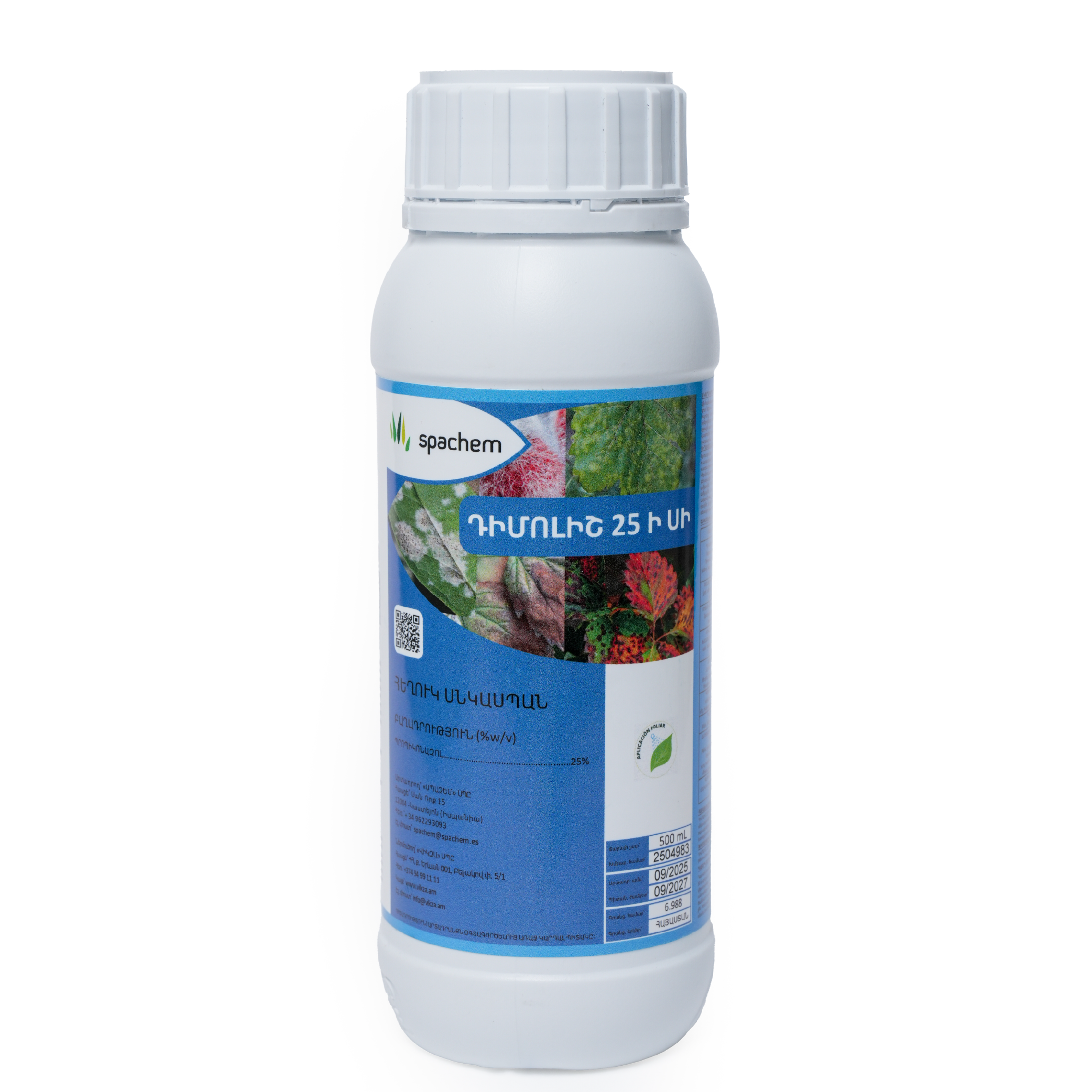
100ml, 250ml, 500ml, 1L, 5L, 10L, 20L, 200L, 1000L

It is a systemic fungicide that quickly penetrates the leaves through the cuticle, moving widely inside them, tending to accumulate at the apical ends. The direction of translocation is acropetal (towards the tips), taking advantage of the xylem current.
It is also a preventive and curative fungicide that inhibits the development of haustoria secondary to sterol demethylation. It inhibits the biosynthesis of ergosterol from cell membranes, stopping the development of fungi. It acts primarily on the development of the pathogen's secondary hyphae within plant tissues, but it also acts, on a smaller scale, on the development and virulence of fungal conidia.
| CROPS | PLAGUE | DOSE (L/Ha) |
|---|---|---|
| Fruit trees (peach, nectarine, plum, cherry, apricot, kumquat, pear, apple, pomegranate, persimmon, fig etc.) | Shot hole disease of stone fruits (Clasterosporium carpophilum) |
0.4 - 0.5 |
| Fruit trees (peach, nectarine, plum, cherry, apricot, kumquat, pear, apple, pomegranate, persimmon, fig etc.) | Pear rust (Gymnosporangium sabinae) |
0.4 - 0.6 |
| Fruit trees (peach, nectarine, plum, cherry, apricot, kumquat, pear, apple, pomegranate, persimmon, fig etc.) | Apple rust (Gymnosporangium tremelloides) |
0.4 - 0.6 |
| Fruit trees (peach, nectarine, plum, cherry, apricot, kumquat, pear, apple, pomegranate, persimmon, fig etc.) | Gray rot of stone fruits (Monilia cinerea) |
0.4 - 0.6 |
| Fruit trees (peach, nectarine, plum, cherry, apricot, kumquat, pear, apple, pomegranate, persimmon, fig etc.) | Fruit rot (Monilia fructigena) |
0.4 - 0.5 Flowering stage |
| Fruit trees (peach, nectarine, plum, cherry, apricot, kumquat, pear, apple, pomegranate, persimmon, fig etc.) | Apple powdery mildew (Podosphaera leucotricha) |
0.4 - 0.6 |
| Fruit trees (peach, nectarine, plum, cherry, apricot, kumquat, pear, apple, pomegranate, persimmon, fig etc.) | Red burn of plums (Polystigma rubrum) |
0.5 After flowering |
| Fruit trees (peach, nectarine, plum, cherry, apricot, kumquat, pear, apple, pomegranate, persimmon, fig etc.) | White pear leaf spot (Septoria piricola) |
0.4 - 0.6 |
| Fruit trees (peach, nectarine, plum, cherry, apricot, kumquat, pear, apple, pomegranate, persimmon, fig etc.) | Powdery mildew of peach (Sphaerotheca pannosa) |
0.3 - 0.5 |
| Fruit trees (peach, nectarine, plum, cherry, apricot, kumquat, pear, apple, pomegranate, persimmon, fig etc.) | Apple scab (Venturia inaequalis) |
0.4 - 0.6 |
| Fruit trees (peach, nectarine, plum, cherry, apricot, kumquat, pear, apple, pomegranate, persimmon, fig etc.) | Pear scab (Venturia pyrina) |
0.4 - 0.6 |
| Fruit trees (peach, nectarine, plum, cherry, apricot, kumquat, pear, apple, pomegranate, persimmon, fig etc.) | Root rot (Fusarium avenaceum) |
0.4 - 0.6 |
| Fruit trees (peach, nectarine, plum, cherry, apricot, kumquat, pear, apple, pomegranate, persimmon, fig etc.) | Root rot (Fusarium graminearum) |
0.4 - 0.6 |
| Fruit trees (peach, nectarine, plum, cherry, apricot, kumquat, pear, apple, pomegranate, persimmon, fig etc.) | Faba bean fusarium wilt (Fusarium oxysporum) |
0.4 - 0.6 |
| Vegetables (tomato, pepper, chili, eggplant, potato, carrot, zucchini) | Carrot black rot (Alternaria radicina) |
0.4 - 0.5 |
| Vegetables (tomato, pepper, chili, eggplant, potato, carrot, zucchini) | Potato brown leaf spot (Cercospora concors) |
0.4 - 0.6 |
| Vegetables (tomato, pepper, chili, eggplant, potato, carrot, zucchini) | Powdery mildew of potato (Erysiphe cichoracearum) |
0.4 - 0.6 |
| Vegetables (tomato, pepper, chili, eggplant, potato, carrot, zucchini) | Powdery mildew of Alfalfa (Erysiphe communis) |
0.4 - 0.6 |
| Vegetables (tomato, pepper, chili, eggplant, potato, carrot, zucchini) | Cabbage root wilt (Fusarium oxysporum var. orthoceras Bil) |
0.4 - 0.5 Soil injection |
| Vegetables (tomato, pepper, chili, eggplant, potato, carrot, zucchini) | Potato rot or fusarium (Fusarium solani) |
0.4 - 0.6 |
| Vegetables (tomato, pepper, chili, eggplant, potato, carrot, zucchini) | Powdery mildew of tomato (Leveillula taurica) |
0.4 - 0.6 |
| Vegetables (tomato, pepper, chili, eggplant, potato, carrot, zucchini) | Macrosporiosis (Macrosporium solani (Alternaria solani)) |
0.4 - 0.5 Soil injection |
| Vegetables (tomato, pepper, chili, eggplant, potato, carrot, zucchini) | Black scurf or rhizoctonia (Rhizoctonia solani) |
0.4 - 0.6 |
| Vegetables (tomato, pepper, chili, eggplant, potato, carrot, zucchini) | Tomato Septoria (Septoria lycopersici) |
0.4 - 0.6 |
| Vegetables (tomato, pepper, chili, eggplant, potato, carrot, zucchini) | Root rot (Fusarium avenaceum) |
0.4 - 0.6 |
| Vegetables (tomato, pepper, chili, eggplant, potato, carrot, zucchini) | Root rot (Fusarium graminearum) |
0.4 - 0.6 |
| Vegetables (tomato, pepper, chili, eggplant, potato, carrot, zucchini) | Faba bean fusarium wilt (Fusarium oxysporum) |
0.4 - 0.6 Soil injection |
| Edible leaf crops (cabbage, lettuce, broccoli, spinach) | Powdery mildew of Alfalfa (Erysiphe communis) |
0.4 - 0.6 |
| Edible leaf crops (cabbage, lettuce, broccoli, spinach) | Root rot (Fusarium avenaceum) |
0.4 - 0.6 |
| Edible leaf crops (cabbage, lettuce, broccoli, spinach) | Root rot (Fusarium graminearum) |
0.4 - 0.6 |
| Edible leaf crops (cabbage, lettuce, broccoli, spinach) | Cabbage root wilt (Fusarium oxysporum var. orthoceras Bil) |
0.4 - 0.5 Soil injection |
| Edible leaf crops (cabbage, lettuce, broccoli, spinach) | Potato rot or fusarium (Fusarium solani) |
0.4 - 0.6 |
| Edible leaf crops (cabbage, lettuce, broccoli, spinach) | Black leg of cabbage seedlings (Opidium brassicae) |
0.4 - 0.6 Soil injection |
| Edible leaf crops (cabbage, lettuce, broccoli, spinach) | Faba bean fusarium wilt (Fusarium oxysporum) |
0.4 - 0.6 |
| Liliaceas and other crucifera (garlic, onion, asparagus, turnip, radishes) | Root rot (Fusarium avenaceum) |
0.4 - 0.6 |
| Liliaceas and other crucifera (garlic, onion, asparagus, turnip, radishes) | Root rot (Fusarium graminearum) |
0.4 - 0.6 |
| Liliaceas and other crucifera (garlic, onion, asparagus, turnip, radishes) | Black leg of cabbage seedlings (Opidium brassicae) |
0.4 - 0.6 Soil injection |
| Liliaceas and other crucifera (garlic, onion, asparagus, turnip, radishes) | Faba bean fusarium wilt (Fusarium oxysporum) |
0.4 - 0.6 |
| Extensive and industrial (wheat, corn, barley, tabaci, beet) | Purple ergot (Claviceps purpurea) |
0.4 - 0.6 |
| Extensive and industrial (wheat, corn, barley, tabaci, beet) | Dry rot of maize (Diplodia zeae) |
0.4 - 0.6 |
| Extensive and industrial (wheat, corn, barley, tabaci, beet) | Powdery mildew of cereals (Erysiphe graminis) |
0.4 - 0.6 |
| Extensive and industrial (wheat, corn, barley, tabaci, beet) | Snow mold (Fusarium nivale) |
0.4 - 0.6 |
| Extensive and industrial (wheat, corn, barley, tabaci, beet) | Helminthosporium/ (Stripe rust) (Helminthosporium gramineum) |
0.4 - 0.6 |
| Extensive and industrial (wheat, corn, barley, tabaci, beet) | Helminthosporium leaf blight (Helminthosporium sativum) |
0.4 - 0.6 |
| Extensive and industrial (wheat, corn, barley, tabaci, beet) | Root rot (Helminthosporium teres) |
0.4 - 0.6 |
| Extensive and industrial (wheat, corn, barley, tabaci, beet) | Oat crown rust (Puccinia coronifera) |
0.4 - 0.6 |
| Extensive and industrial (wheat, corn, barley, tabaci, beet) | Wheat yellow rust (Puccinia glumarum) |
0.4 - 0.6 |
| Extensive and industrial (wheat, corn, barley, tabaci, beet) | Stem or linear rust (Puccinia graminis) |
0.4 - 0.6 |
| Extensive and industrial (wheat, corn, barley, tabaci, beet) | Sunflower rust (Puccinia helianthi) |
0.4 - 0.6 |
| Extensive and industrial (wheat, corn, barley, tabaci, beet) | Dwarf leaf rust of barley (Puccinia hordei) |
0.4 - 0.6 |
| Extensive and industrial (wheat, corn, barley, tabaci, beet) | Rust of maize (Puccinia maydis) |
0.4 - 0.6 |
| Extensive and industrial (wheat, corn, barley, tabaci, beet) | Barley rust (Puccinia simplex) |
0.4 - 0.6 |
| Extensive and industrial (wheat, corn, barley, tabaci, beet) | Wheat leaf brown rust (Puccinia triticina) |
0.4 - 0.6 |
| Extensive and industrial (wheat, corn, barley, tabaci, beet) | Cotton rot (Rhizoctonia Aderholdii Kolosch) |
0.4 - 0.6 |
| Extensive and industrial (wheat, corn, barley, tabaci, beet) | Black scurf or rhizoctonia (Rhizoctonia solani) |
0.4 - 0.6 |
| Extensive and industrial (wheat, corn, barley, tabaci, beet) | Covered smut of wheat (Tilletia caries) |
0.3 - 0.5 |
| Extensive and industrial (wheat, corn, barley, tabaci, beet) | Dwarf bunt of wheat (Tilletia controversa) |
0.3 - 0.5 |
| Extensive and industrial (wheat, corn, barley, tabaci, beet) | Covered smut of barley (Ustilago hordei) |
0.3 - 0.5 |
| Extensive and industrial (wheat, corn, barley, tabaci, beet) | Loose smut of barley (Ustilago nuda) |
0.3 - 0.5 |
| Extensive and industrial (wheat, corn, barley, tabaci, beet) | Loose smut of wheat (Ustilago tritici) |
0.3 - 0.5 |
| Extensive and industrial (wheat, corn, barley, tabaci, beet) | Root rot (Fusarium avenaceum) |
0.4 - 0.6 |
| Extensive and industrial (wheat, corn, barley, tabaci, beet) | Root rot (Fusarium graminearum) |
0.4 - 0.6 |
| Extensive and industrial (wheat, corn, barley, tabaci, beet) | Helminthosporium (Helminthosporium spp) |
0.4 - 0.6 |
| Extensive and industrial (wheat, corn, barley, tabaci, beet) | Cercosporiosis (Cercospora spp) |
0.4 - 0.6 |
| Extensive and industrial (wheat, corn, barley, tabaci, beet) | Leaf spot (Rhynchosporium spp) |
0.4 - 0.6 |
| Extensive and industrial (wheat, corn, barley, tabaci, beet) | Rust (Phakopsora spp) |
0.4 - 0.6 |
| Extensive and industrial (wheat, corn, barley, tabaci, beet) | Rust (Puccinia spp) |
0.4 - 0.6 |
| Extensive and industrial (wheat, corn, barley, tabaci, beet) | Faba bean fusarium wilt (Fusarium oxysporum) |
0.4 - 0.6 |
| Berries (strawberry, raspberry, blueberry, blackberries, currant, vine) | Gray mold of grapes (Botrytis cinerea) |
0.4 - 0.6 Pre-flowering and fruit set |
| Berries (strawberry, raspberry, blueberry, blackberries, currant, vine) | Mulberry rust (Phragmidium rubi) |
0.4 - 0.6 Early stage |
| Berries (strawberry, raspberry, blueberry, blackberries, currant, vine) | Fake downy mildew of grapes (Plasmopara viticola) |
0.4 - 0.6 |
| Berries (strawberry, raspberry, blueberry, blackberries, currant, vine) | Currant rust (Puccinia ribis) |
0.4 - 0.6 |
| Berries (strawberry, raspberry, blueberry, blackberries, currant, vine) | Strawberry white spot (Ramularia tulasnei) |
0.4 - 0.6 |
| Berries (strawberry, raspberry, blueberry, blackberries, currant, vine) | Powdery mildew of strawberry (Sphaerotheca macularis f. fragariae) |
0.4 - 0.6 |
| Berries (strawberry, raspberry, blueberry, blackberries, currant, vine) | Grape powdery mildew (Uncinula necator) |
0.4 - 0.6 |
| Berries (strawberry, raspberry, blueberry, blackberries, currant, vine) | Root rot (Fusarium avenaceum) |
0.4 - 0.6 |
| Berries (strawberry, raspberry, blueberry, blackberries, currant, vine) | Root rot (Fusarium graminearum) |
0.4 - 0.6 |
| Berries (strawberry, raspberry, blueberry, blackberries, currant, vine) | Faba bean fusarium wilt (Fusarium oxysporum) |
0.4 - 0.6 |
| Cucurbitaceas (melon, watermelon, pumpkin) | Powdery mildew of cucurbits (Erysiphe fuliginea) |
0.4 - 0.6 |
| Cucurbitaceas (melon, watermelon, pumpkin) | Root rot (Fusarium avenaceum) |
0.4 - 0.6 |
| Cucurbitaceas (melon, watermelon, pumpkin) | Root rot (Fusarium graminearum) |
0.4 - 0.6 |
| Cucurbitaceas (melon, watermelon, pumpkin) | Faba bean fusarium wilt (Fusarium oxysporum) |
0.4 - 0.6 |
| Aromatic and ornamental (cilantro, parsley, mint, sage, rosemary, thyme, tarragon, rose, gerberas, thuja, fir tree, carnations) | Root rot (Fusarium avenaceum) |
0.4 - 0.6 |
| Aromatic and ornamental (cilantro, parsley, mint, sage, rosemary, thyme, tarragon, rose, gerberas, thuja, fir tree, carnations) | Root rot (Fusarium graminearum) |
0.4 - 0.6 |
| Aromatic and ornamental (cilantro, parsley, mint, sage, rosemary, thyme, tarragon, rose, gerberas, thuja, fir tree, carnations) | Faba bean fusarium wilt (Fusarium oxysporum) |
0.4 - 0.6 |
| Legumes (beans, peas, lentils) | Ascochyta blight of Alfalfa (Ascochyta imperfecta) |
0.4 - 0.6 |
| Legumes (beans, peas, lentils) | Ascochyta blight of sainfoin (Ascochyta onobrychis) |
0.4 - 0.6 |
| Legumes (beans, peas, lentils) | Ascochyta blight of pea (Ascochyta pisi) |
0.4 - 0.6 |
| Legumes (beans, peas, lentils) | Powdery mildew of Alfalfa (Erysiphe communis) |
0.4 - 0.6 |
| Legumes (beans, peas, lentils) | Bean anthracnose (Colletotrichum lindemuthianum) |
0.4 - 0.6 |
| Legumes (beans, peas, lentils) | Clover anthracnose (Kabatiella caulivora) |
0.4 - 0.6 |
| Legumes (beans, peas, lentils) | Faba bean rust (Uromyces fabae) |
0.4 - 0.6 |
| Legumes (beans, peas, lentils) | Clover rust (Uromyces fallens) |
0.4 - 0.6 |
| Legumes (beans, peas, lentils) | Bean rust (Uromyces phaseoli) |
0.4 - 0.6 |
| Legumes (beans, peas, lentils) | Pea rust (Uromyces pisi) |
0.4 - 0.6 |
| Legumes (beans, peas, lentils) | Alfalfa rust (Uromyces striatus) |
0.4 - 0.6 |
| Legumes (beans, peas, lentils) | Root rot (Fusarium avenaceum) |
0.4 - 0.6 |
| Legumes (beans, peas, lentils) | Root rot (Fusarium graminearum) |
0.4 - 0.6 |
| Legumes (beans, peas, lentils) | Sainfoin rust (Uromyces onobrychidis) |
0.4 - 0.6 |
| Legumes (beans, peas, lentils) | 0.4 - 0.6 | |
| Legumes (beans, peas, lentils) | Faba bean fusarium wilt (Fusarium oxysporum) |
0.4 - 0.6 |
Demolish 25 EC
It is a systemic fungicide that quickly penetrates the leaves through the cuticle, moving widely inside them, tending to accumulate at the apical ends. The direction of translocation is acropetal (towards the tips), taking advantage of the xylem current.
It is also a preventive and curative fungicide that inhibits the development of haustoria secondary to sterol demethylation. It inhibits the biosynthesis of ergosterol from cell membranes, stopping the development of fungi. It acts primarily on the development of the pathogen's secondary hyphae within plant tissues, but it also acts, on a smaller scale, on the development and virulence of fungal conidia.
-
Propiconazole
25.0 %
RE-ENTRY INTERVAL TO THE TREATED AREA
Wait 4 hours. If it is necessary to enter before this period, full protective equipment must be used.
INTERVAL BETWEEN LAST APPLICATION AND HARVEST (WAITING PERIOD)
24 h.
MAXIMUM NUMBER OF TREATMENTS
Make the first application in preventively or when the first symptoms of the disease. 3 Applications per season maximum.
Regulate the pH.
The effectivenes of treatments are provided by a complete follage wettiness and use of adjuvant.
TIME OF EMPLOYMENTThe application of the product can be carried out with ground equipment (motorized backpack pumps, equipped with centrifugal pump and rotary terminals) and aerial equipment (aircraft or helicopters equipped with "micronairs" or controlled drop devices).
In land-based applications, use a minimum volume of water of 200 liters/ha, with pressure of 4- 5.5 bar (60-80 psi) and hollow cone spouts preferably. Do not carry out mechanized land applications in extensive crops (cereals, oilseeds and fodder) at a distance of less than 300 meters from any urban or suburban area and population center. In case of aerial applications, use a minimum volume of water of 20 litres/ha. Do not carry out aerial applications at a distance of less than 500 m from any urban or suburban area and population center.
It should be applied to the crop in the volume necessary to cover evenly and satisfactorily the area to be treated, especially on the underside of the leaves. At least 40 impacts/cm2 must be achieved on the leaves of the crop that we must protect. Do not apply with winds above 10 km/h, temperatures above 29 °C and relative humidity below 60%. Do not apply if the foliage is wet or there is a possibility of imminent rain. Incompatible with products with a strong alkaline reaction.
Before starting any treatment, it is essential to verify the correct calibration of the equipment and the proper functioning of the nozzles (filters and tablets), replacing the defective parts. Keep the stirring system moving at all times. Avoid overlapping stripes during spraying. Avoid drifting towards neighboring crops. Do not apply with high temperatures, low humidity, strong winds, dew or rain probabilities. Apply away from springs, streams or water sources. Always calibrate your equipment with water only before applying the product. Remember to get the right auxiliary equipment (solid and liquid product meters, graduated trays, stirring paddles, brushes, brushes, etc.).
DEMOLISH 25 EC is incompatible with strongly oxidizing materials. The product is compatible with many other fungicides when used at normal rates. However, a compatibility test is recommended before being used with other products. Do not directly mix the concentrate with other concentrated herbicides or pesticides, always dilute it first.
PHYTOTOXICITYDEMOLISH 25 EC is not phytotoxic at recommended doses. In case of mixing, perform a small-scale test to check compatibility and phytotoxicity.
REMARKS
The recommendations and information we provide are the result of extensive and rigorous studies and tests, however, numerous factors beyond our control may intervene in the use (preparation of mixtures, application, weather, etc.). The company guarantees the composition, formulation and content. The user will be liable for any damage caused ( lack of efficacy, general toxicity, residues, etc.) due to total or partial non-observance of the label instructions.
- Verify the correct calibration of the equipment before starting the application
- Put water halfway up the tank of the applicator equipment, add the necessary amount of DEMOLISH 25 EC product according to the dose recommended on this label, keeping the shaker running and top up with the rest of the volume of water.
- It is recommended to add a non-ionic adjuvant to improve coverage.
- Before starting any treatment, it is essential to verify the correct calibration of the equipment and the proper functioning of the nozzles (filters and pads), replacing the defective parts.
- Do not perform applications with high temperatures.
- Apply away from springs, courses, or fountains.
- Always calibrate your equipment with water only before applying the product.
- Remember to get the right auxiliary equipment (solid and liquid product meters), graduated trays, stirring paddles, brushes, brushes, etc.
- Use the following protective equipment for mixing, loading, and applying: boots, mask, goggles, gloves, and dispenser.
The icon identifies products designed for direct application to leaves, where nutrients and biostimulants are rapidly absorbed through the stomatal and cuticular pathways.