


Ionic 10 EW
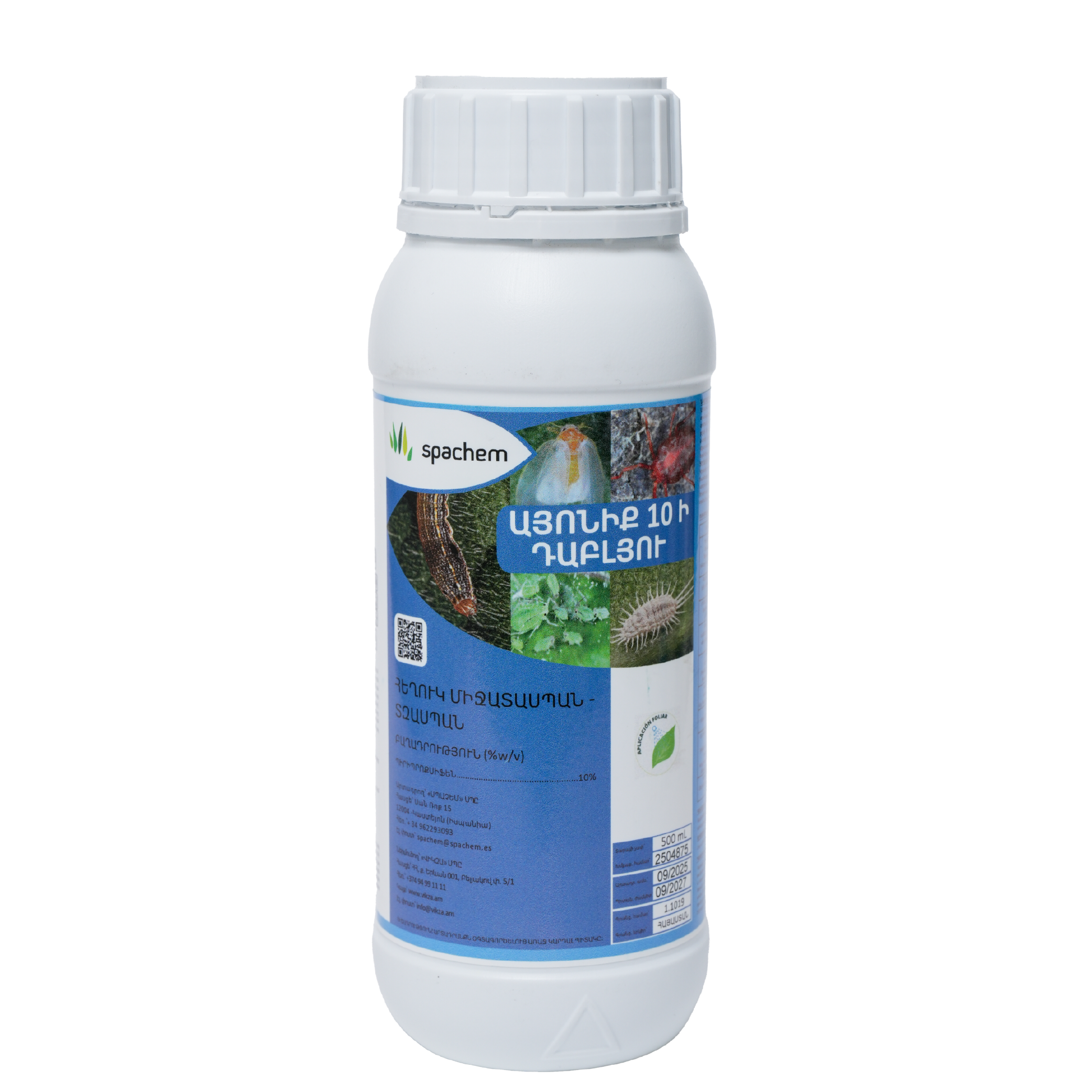
100ml, 250ml, 500ml, 1L, 5L, 10L, 20L, 200L, 1000L

IONIC 10 EW is an insecticide-acaricide derived from pyridine that has insecticidal activity by contact, translaminar and ingestion (Growth regulator), behaving as a juvenile hormonal and acting on the growth of insects.
It controls various pests in fruit trees and tomatoes such as: white flies, black shell, white scale, apple moth, carob moth and pear tree psyllid, as appropriate.
| CROPS | Pests | DOSE (L/Ha) |
|---|---|---|
| Fruit trees (peach, nectarine, plum, cherry, apricot, kumquat, pear, apple, pomegranate, persimmon, fig etc.) | Moths (Heliothis spp) |
0.5 - 0.75 |
| Fruit trees (peach, nectarine, plum, cherry, apricot, kumquat, pear, apple, pomegranate, persimmon, fig etc.) | Western flower thrips (Frankliniella occidentalis) |
0.3 - 0.4 |
| Fruit trees (peach, nectarine, plum, cherry, apricot, kumquat, pear, apple, pomegranate, persimmon, fig etc.) | Glasshouse whitefly (Trialeurodes vaporariorum) |
0.3 - 0.4 |
| Fruit trees (peach, nectarine, plum, cherry, apricot, kumquat, pear, apple, pomegranate, persimmon, fig etc.) | Apple leaf sucker (Psylla mali) |
0.3 - 0.4 |
| Fruit trees (peach, nectarine, plum, cherry, apricot, kumquat, pear, apple, pomegranate, persimmon, fig etc.) | Woolly apple aphid (Eriosoma lanigerum) |
0.3 - 0.4 |
| Fruit trees (peach, nectarine, plum, cherry, apricot, kumquat, pear, apple, pomegranate, persimmon, fig etc.) | Green apple aphid (Apհis pomi) |
0.3 - 0.4 |
| Fruit trees (peach, nectarine, plum, cherry, apricot, kumquat, pear, apple, pomegranate, persimmon, fig etc.) | Apple blossom weevil (Anthonomus pomorum) |
0.3 - 0.4 |
| Fruit trees (peach, nectarine, plum, cherry, apricot, kumquat, pear, apple, pomegranate, persimmon, fig etc.) | Red-belted clearwing (Synanthedon myopaeformis) |
0.3 - 0.4 |
| Fruit trees (peach, nectarine, plum, cherry, apricot, kumquat, pear, apple, pomegranate, persimmon, fig etc.) | Codling moth (Laspeyresia pomonella) |
0.3 - 0.4 |
| Fruit trees (peach, nectarine, plum, cherry, apricot, kumquat, pear, apple, pomegranate, persimmon, fig etc.) | Orchard ermine (Yponomeuta malinella) |
0.3 - 0.4 |
| Fruit trees (peach, nectarine, plum, cherry, apricot, kumquat, pear, apple, pomegranate, persimmon, fig etc.) | Pear psylla (Psylla pyri) |
0.3 - 0.4 |
| Fruit trees (peach, nectarine, plum, cherry, apricot, kumquat, pear, apple, pomegranate, persimmon, fig etc.) | Pear lace bug (Stephanitis pyri) |
0.3 - 0.4 |
| Fruit trees (peach, nectarine, plum, cherry, apricot, kumquat, pear, apple, pomegranate, persimmon, fig etc.) | Pear sawfly (Hoplocampa brevis) |
0.3 - 0.4 |
| Fruit trees (peach, nectarine, plum, cherry, apricot, kumquat, pear, apple, pomegranate, persimmon, fig etc.) | Buffalo treehopper (Stictocephala bubalus) |
0.3 - 0.4 |
| Fruit trees (peach, nectarine, plum, cherry, apricot, kumquat, pear, apple, pomegranate, persimmon, fig etc.) | Orchard ermine (Yponomeuta padella) |
0.3 - 0.4 |
| Fruit trees (peach, nectarine, plum, cherry, apricot, kumquat, pear, apple, pomegranate, persimmon, fig etc.) | Orchard ermine (Yponomeuta padella) |
0.3 - 0.4 |
| Fruit trees (peach, nectarine, plum, cherry, apricot, kumquat, pear, apple, pomegranate, persimmon, fig etc.) | Brown peach aphid (Pterochloroides persicae) |
0.3 - 0.4 |
| Fruit trees (peach, nectarine, plum, cherry, apricot, kumquat, pear, apple, pomegranate, persimmon, fig etc.) | Flatheaded woodborer (Capnodis tenebrionis) |
0.3 - 0.4 |
| Fruit trees (peach, nectarine, plum, cherry, apricot, kumquat, pear, apple, pomegranate, persimmon, fig etc.) | Oriental fruit moth (Grapholita molesta) |
0.3 - 0.4 |
| Fruit trees (peach, nectarine, plum, cherry, apricot, kumquat, pear, apple, pomegranate, persimmon, fig etc.) | Peach wasp (Sphenoptera anthaxoides) |
0.3 - 0.4 |
| Fruit trees (peach, nectarine, plum, cherry, apricot, kumquat, pear, apple, pomegranate, persimmon, fig etc.) | Green peach aphid (Myzodes persicae) |
0.3 - 0.4 |
| Fruit trees (peach, nectarine, plum, cherry, apricot, kumquat, pear, apple, pomegranate, persimmon, fig etc.) | Lesser bud moth (Recurvaria nanella) |
0.3 - 0.4 |
| Fruit trees (peach, nectarine, plum, cherry, apricot, kumquat, pear, apple, pomegranate, persimmon, fig etc.) | Plum Fruitworm (Laspeyresia funebrana) |
0.3 - 0.4 |
| Fruit trees (peach, nectarine, plum, cherry, apricot, kumquat, pear, apple, pomegranate, persimmon, fig etc.) | Plum-fruit sawfly (Hoplocampa Fulvicornis) |
0.3 - 0.4 |
| Fruit trees (peach, nectarine, plum, cherry, apricot, kumquat, pear, apple, pomegranate, persimmon, fig etc.) | Almond seed wasp (Eurytoma amygdali) |
0.3 - 0.4 |
| Fruit trees (peach, nectarine, plum, cherry, apricot, kumquat, pear, apple, pomegranate, persimmon, fig etc.) | Cherry blackfly (Myzus cerasi) |
0.3 - 0.4 |
| Fruit trees (peach, nectarine, plum, cherry, apricot, kumquat, pear, apple, pomegranate, persimmon, fig etc.) | Cherry-fruit weevil (Rhynchites auratus) |
0.3 - 0.4 |
| Fruit trees (peach, nectarine, plum, cherry, apricot, kumquat, pear, apple, pomegranate, persimmon, fig etc.) | Cherry slug sawfly (Caliroa limacina) |
0.3 - 0.4 |
| Fruit trees (peach, nectarine, plum, cherry, apricot, kumquat, pear, apple, pomegranate, persimmon, fig etc.) | Cherry fruit fly (Rhagoletis cerasi) |
0.3 - 0.4 |
| Fruit trees (peach, nectarine, plum, cherry, apricot, kumquat, pear, apple, pomegranate, persimmon, fig etc.) | Apple leaf cutter (Coenorrhinus pauxillus) |
0.3 - 0.4 |
| Fruit trees (peach, nectarine, plum, cherry, apricot, kumquat, pear, apple, pomegranate, persimmon, fig etc.) | Fruit Goose (Rhynchites bacchus) |
0.3 - 0.4 |
| Fruit trees (peach, nectarine, plum, cherry, apricot, kumquat, pear, apple, pomegranate, persimmon, fig etc.) | Leopard moth (Zeuzera pyrina) |
0.3 - 0.4 |
| Fruit trees (peach, nectarine, plum, cherry, apricot, kumquat, pear, apple, pomegranate, persimmon, fig etc.) | Apple blossom beetle (Tropinota hirta) |
0.3 - 0.4 |
| Fruit trees (peach, nectarine, plum, cherry, apricot, kumquat, pear, apple, pomegranate, persimmon, fig etc.) | Apple fruit moth (Argyresthia conjugella) |
0.3 - 0.4 |
| Fruit trees (peach, nectarine, plum, cherry, apricot, kumquat, pear, apple, pomegranate, persimmon, fig etc.) | Black-veined white (Aporia crataegi) |
0.3 - 0.4 |
| Fruit trees (peach, nectarine, plum, cherry, apricot, kumquat, pear, apple, pomegranate, persimmon, fig etc.) | Winter moth (Operophtera brumata) |
0.3 - 0.4 |
| Fruit trees (peach, nectarine, plum, cherry, apricot, kumquat, pear, apple, pomegranate, persimmon, fig etc.) | Lackey moth (Malacosoma neustria) |
0.3 - 0.4 |
| Fruit trees (peach, nectarine, plum, cherry, apricot, kumquat, pear, apple, pomegranate, persimmon, fig etc.) | The brown-tail moth (Euproctis chrysorrhoea) |
0.3 - 0.4 |
| Fruit trees (peach, nectarine, plum, cherry, apricot, kumquat, pear, apple, pomegranate, persimmon, fig etc.) | Gypsy moth (Ocneria dispar) |
0.3 - 0.4 |
| Fruit trees (peach, nectarine, plum, cherry, apricot, kumquat, pear, apple, pomegranate, persimmon, fig etc.) | Peach twig borer (Anarsia lineatella) |
0.3 - 0.4 |
| Fruit trees (peach, nectarine, plum, cherry, apricot, kumquat, pear, apple, pomegranate, persimmon, fig etc.) | Strawberry tarsonemid mite (Tarsonemus fragariae) |
0.3 - 0.4 |
| Fruit trees (peach, nectarine, plum, cherry, apricot, kumquat, pear, apple, pomegranate, persimmon, fig etc.) | Comstock mealybug (Pseudococcus comstocki) |
0.3 - 0.5 |
| Fruit trees (peach, nectarine, plum, cherry, apricot, kumquat, pear, apple, pomegranate, persimmon, fig etc.) | European fruit lecanium (Parthenolecanium corni) |
0.3 - 0.5 |
| Fruit trees (peach, nectarine, plum, cherry, apricot, kumquat, pear, apple, pomegranate, persimmon, fig etc.) | Olive scale (Parlatoria oleae) |
0.3 - 0.5 |
| Fruit trees (peach, nectarine, plum, cherry, apricot, kumquat, pear, apple, pomegranate, persimmon, fig etc.) | Transcaucasia marble beetle (Polyphylla olivieri) |
0.5 - 1.0 |
| Fruit trees (peach, nectarine, plum, cherry, apricot, kumquat, pear, apple, pomegranate, persimmon, fig etc.) | Red spider mite (Tetranychus urticae) |
0.5 - 1.0 |
| Fruit trees (peach, nectarine, plum, cherry, apricot, kumquat, pear, apple, pomegranate, persimmon, fig etc.) | Whitefly (Aleurotrachelus spp) |
0.5 - 0.75 |
| Fruit trees (peach, nectarine, plum, cherry, apricot, kumquat, pear, apple, pomegranate, persimmon, fig etc.) | Scales (Aspidiotus Nerii, Parlatoria Pergandii, Fiorinia Fioriniae, Bombacoccus aguacatae, Hemiberlesia lataniae) |
0.5 - 0.75 |
| Fruit trees (peach, nectarine, plum, cherry, apricot, kumquat, pear, apple, pomegranate, persimmon, fig etc.) | Reed aphid (Hyalopterus arundiniformis) |
0.3 - 0.4 |
| Fruit trees (peach, nectarine, plum, cherry, apricot, kumquat, pear, apple, pomegranate, persimmon, fig etc.) | Grape (citrus) mealybug (Pseudococcus citri) |
0.5 - 1.0 |
| Vegetables (tomato, pepper, chili, eggplant, potato, carrot, zucchini) | Tobacco whitefly (Bemisia tabaci) |
0.5 - 0.75 |
| Vegetables (tomato, pepper, chili, eggplant, potato, carrot, zucchini) | Western flower thrips (Frankliniella occidentalis) |
0.3 - 0.4 |
| Vegetables (tomato, pepper, chili, eggplant, potato, carrot, zucchini) | Glasshouse whitefly (Trialeurodes vaporariorum) |
0.3 - 0.4 |
| Vegetables (tomato, pepper, chili, eggplant, potato, carrot, zucchini) | Cotton aphid (Aphis gossypii) |
0.3 - 0.4 |
| Vegetables (tomato, pepper, chili, eggplant, potato, carrot, zucchini) | Green peach aphid (Myzodes persicae) |
0.3 - 0.4 |
| Vegetables (tomato, pepper, chili, eggplant, potato, carrot, zucchini) | Strawberry tarsonemid mite (Tarsonemus fragariae) |
0.3 - 0.4 |
| Vegetables (tomato, pepper, chili, eggplant, potato, carrot, zucchini) | Red spider mite (Tetranychus urticae) |
0.5 - 1.0 |
| Edible leaf crops (cabbage, lettuce, broccoli, spinach) | Tobacco whitefly (Bemisia tabaci) |
0.5 - 0.75 |
| Edible leaf crops (cabbage, lettuce, broccoli, spinach) | Western flower thrips (Frankliniella occidentalis) |
0.3 - 0.4 |
| Edible leaf crops (cabbage, lettuce, broccoli, spinach) | Glasshouse whitefly (Trialeurodes vaporariorum) |
0.3 - 0.4 |
| Edible leaf crops (cabbage, lettuce, broccoli, spinach) | Cotton aphid (Aphis gossypii) |
0.3 - 0.4 |
| Edible leaf crops (cabbage, lettuce, broccoli, spinach) | Strawberry tarsonemid mite (Tarsonemus fragariae) |
0.3 - 0.4 |
| Edible leaf crops (cabbage, lettuce, broccoli, spinach) | Red spider mite (Tetranychus urticae) |
0.5 - 1.0 |
| Liliaceas and other crucifera (garlic, onion, asparagus, turnip, radishes) | Tobacco whitefly (Bemisia tabaci) |
0.5 - 0.75 |
| Liliaceas and other crucifera (garlic, onion, asparagus, turnip, radishes) | Western flower thrips (Frankliniella occidentalis) |
0.3 - 0.4 |
| Liliaceas and other crucifera (garlic, onion, asparagus, turnip, radishes) | Glasshouse whitefly (Trialeurodes vaporariorum) |
0.3 - 0.4 |
| Liliaceas and other crucifera (garlic, onion, asparagus, turnip, radishes) | Red spider mite (Tetranychus urticae) |
0.5 - 1.0 |
| Extensive and industrial (wheat, corn, barley, tabaci, beet) | Spring green aphid (Schizaphis graminum) |
0.3 - 0.4 |
| Extensive and industrial (wheat, corn, barley, tabaci, beet) | Grain Aphid (Sitobion avenae) |
0.3 - 0.4 |
| Extensive and industrial (wheat, corn, barley, tabaci, beet) | Strawberry tarsonemid mite (Tarsonemus fragariae) |
0.3 - 0.4 |
| Extensive and industrial (wheat, corn, barley, tabaci, beet) | Red spider mite (Tetranychus urticae) |
0.5 - 1.0 |
| Berries (strawberry, raspberry, blueberry, blackberries, currant, vine) | Western flower thrips (Frankliniella occidentalis) |
0.3 - 0.4 |
| Berries (strawberry, raspberry, blueberry, blackberries, currant, vine) | Glasshouse whitefly (Trialeurodes vaporariorum) |
0.3 - 0.4 |
| Berries (strawberry, raspberry, blueberry, blackberries, currant, vine) | The brown-tail moth (Euproctis chrysorrhoea) |
0.3 - 0.4 |
| Berries (strawberry, raspberry, blueberry, blackberries, currant, vine) | Gypsy moth (Ocneria dispar) |
0.3 - 0.4 |
| Berries (strawberry, raspberry, blueberry, blackberries, currant, vine) | Strawberry tarsonemid mite (Tarsonemus fragariae) |
0.3 - 0.4 |
| Berries (strawberry, raspberry, blueberry, blackberries, currant, vine) | European fruit lecanium (Parthenolecanium corni) |
0.3 - 0.5 |
| Berries (strawberry, raspberry, blueberry, blackberries, currant, vine) | Grape thrips (Drepanothrips reuteri) |
0.5 - 1.0 |
| Berries (strawberry, raspberry, blueberry, blackberries, currant, vine) | Grape phylloxera (Phylloxera vastatrix) |
0.5 - 1.0 |
| Berries (strawberry, raspberry, blueberry, blackberries, currant, vine) | European grapevine moth (Polychrosis botrana) |
0.5 - 1.0 |
| Berries (strawberry, raspberry, blueberry, blackberries, currant, vine) | Transcaucasia marble beetle (Polyphylla olivieri) |
0.5 - 1.0 |
| Berries (strawberry, raspberry, blueberry, blackberries, currant, vine) | Red spider mite (Tetranychus urticae) |
0.5 - 1.0 |
| Berries (strawberry, raspberry, blueberry, blackberries, currant, vine) | Grape Spider Mite (Schizotetranychus viticola) |
0.5 - 1.0 |
| Berries (strawberry, raspberry, blueberry, blackberries, currant, vine) | Grape erineum mite (Eriophyes vitis) |
0.5 - 1.0 |
| Berries (strawberry, raspberry, blueberry, blackberries, currant, vine) | Grape leafhopper (Zygina párvula) |
0.5 - 1.0 |
| Berries (strawberry, raspberry, blueberry, blackberries, currant, vine) | Comstock mealybug (Pseudococcus comstocki) |
0.3 - 0.5 |
| Berries (strawberry, raspberry, blueberry, blackberries, currant, vine) | Olive scale (Parlatoria oleae) |
0.3 - 0.5 |
| Berries (strawberry, raspberry, blueberry, blackberries, currant, vine) | Grape (citrus) mealybug (Pseudococcus citri) |
0.5 - 1.0 |
| Cucurbitaceas (melon, watermelon, pumpkin) | Western flower thrips (Frankliniella occidentalis) |
0.3 - 0.4 |
| Cucurbitaceas (melon, watermelon, pumpkin) | Glasshouse whitefly (Trialeurodes vaporariorum) |
0.3 - 0.4 |
| Cucurbitaceas (melon, watermelon, pumpkin) | Cotton aphid (Aphis gossypii) |
0.3 - 0.4 |
| Cucurbitaceas (melon, watermelon, pumpkin) | Red spider mite (Tetranychus urticae) |
0.5 - 1.0 |
| Aromatic and ornamental (cilantro, parsley, mint, sage, rosemary, thyme, tarragon, rose, gerberas, thuja, fir tree, carnations) | Tobacco whitefly (Bemisia tabaci) |
0.5 - 0.75 |
| Aromatic and ornamental (cilantro, parsley, mint, sage, rosemary, thyme, tarragon, rose, gerberas, thuja, fir tree, carnations) | Miners (Liriomyza spp) |
0.4 - 0.6 |
| Aromatic and ornamental (cilantro, parsley, mint, sage, rosemary, thyme, tarragon, rose, gerberas, thuja, fir tree, carnations) | Western flower thrips (Frankliniella occidentalis) |
0.3 - 0.4 |
| Aromatic and ornamental (cilantro, parsley, mint, sage, rosemary, thyme, tarragon, rose, gerberas, thuja, fir tree, carnations) | Glasshouse whitefly (Trialeurodes vaporariorum) |
0.3 - 0.4 |
| Aromatic and ornamental (cilantro, parsley, mint, sage, rosemary, thyme, tarragon, rose, gerberas, thuja, fir tree, carnations) | Green apple aphid (Apհis pomi) |
0.3 - 0.4 |
| Aromatic and ornamental (cilantro, parsley, mint, sage, rosemary, thyme, tarragon, rose, gerberas, thuja, fir tree, carnations) | Green peach aphid (Myzodes persicae) |
0.3 - 0.4 |
| Aromatic and ornamental (cilantro, parsley, mint, sage, rosemary, thyme, tarragon, rose, gerberas, thuja, fir tree, carnations) | Winter moth (Operophtera brumata) |
0.3 - 0.4 |
| Aromatic and ornamental (cilantro, parsley, mint, sage, rosemary, thyme, tarragon, rose, gerberas, thuja, fir tree, carnations) | The brown-tail moth (Euproctis chrysorrhoea) |
0.3 - 0.4 |
| Aromatic and ornamental (cilantro, parsley, mint, sage, rosemary, thyme, tarragon, rose, gerberas, thuja, fir tree, carnations) | Strawberry tarsonemid mite (Tarsonemus fragariae) |
0.3 - 0.4 |
| Aromatic and ornamental (cilantro, parsley, mint, sage, rosemary, thyme, tarragon, rose, gerberas, thuja, fir tree, carnations) | Comstock mealybug (Pseudococcus comstocki) |
0.3 - 0.5 |
| Aromatic and ornamental (cilantro, parsley, mint, sage, rosemary, thyme, tarragon, rose, gerberas, thuja, fir tree, carnations) | Olive scale (Parlatoria oleae) |
0.3 - 0.5 |
| Aromatic and ornamental (cilantro, parsley, mint, sage, rosemary, thyme, tarragon, rose, gerberas, thuja, fir tree, carnations) | Red spider mite (Tetranychus urticae) |
0.5 - 1.0 |
| Aromatic and ornamental (cilantro, parsley, mint, sage, rosemary, thyme, tarragon, rose, gerberas, thuja, fir tree, carnations) | Woolly apple aphid (Eriosoma lanigerum) |
0.3 - 0.4 |
| Aromatic and ornamental (cilantro, parsley, mint, sage, rosemary, thyme, tarragon, rose, gerberas, thuja, fir tree, carnations) | Red-belted clearwing (Synanthedon myopaeformis) |
0.3 - 0.4 |
| Aromatic and ornamental (cilantro, parsley, mint, sage, rosemary, thyme, tarragon, rose, gerberas, thuja, fir tree, carnations) | Orchard ermine (Yponomeuta malinella) |
0.3 - 0.4 |
| Aromatic and ornamental (cilantro, parsley, mint, sage, rosemary, thyme, tarragon, rose, gerberas, thuja, fir tree, carnations) | Flatheaded woodborer (Capnodis tenebrionis) |
0.3 - 0.4 |
| Aromatic and ornamental (cilantro, parsley, mint, sage, rosemary, thyme, tarragon, rose, gerberas, thuja, fir tree, carnations) | Peach wasp (Sphenoptera anthaxoides) |
0.3 - 0.4 |
| Aromatic and ornamental (cilantro, parsley, mint, sage, rosemary, thyme, tarragon, rose, gerberas, thuja, fir tree, carnations) | Leopard moth (Zeuzera pyrina) |
0.3 - 0.4 |
| Aromatic and ornamental (cilantro, parsley, mint, sage, rosemary, thyme, tarragon, rose, gerberas, thuja, fir tree, carnations) | Apple fruit moth (Argyresthia conjugella) |
0.3 - 0.4 |
| Aromatic and ornamental (cilantro, parsley, mint, sage, rosemary, thyme, tarragon, rose, gerberas, thuja, fir tree, carnations) | Black-veined white (Aporia crataegi) |
0.3 - 0.4 |
| Aromatic and ornamental (cilantro, parsley, mint, sage, rosemary, thyme, tarragon, rose, gerberas, thuja, fir tree, carnations) | Lackey moth (Malacosoma neustria) |
0.3 - 0.4 |
| Aromatic and ornamental (cilantro, parsley, mint, sage, rosemary, thyme, tarragon, rose, gerberas, thuja, fir tree, carnations) | Gypsy moth (Ocneria dispar) |
0.3 - 0.4 |
| Aromatic and ornamental (cilantro, parsley, mint, sage, rosemary, thyme, tarragon, rose, gerberas, thuja, fir tree, carnations) | European fruit lecanium (Parthenolecanium corni) |
0.3 - 0.5 |
| Legumes (beans, peas, lentils) | Tobacco whitefly (Bemisia tabaci) |
0.5 - 0.75 |
| Legumes (beans, peas, lentils) | Western flower thrips (Frankliniella occidentalis) |
0.3 - 0.4 |
| Legumes (beans, peas, lentils) | Glasshouse whitefly (Trialeurodes vaporariorum) |
0.3 - 0.4 |
| Legumes (beans, peas, lentils) | Strawberry tarsonemid mite (Tarsonemus fragariae) |
0.3 - 0.4 |
| Legumes (beans, peas, lentils) | Red spider mite (Tetranychus urticae) |
0.5 - 1.0 |
Ionic 10 EW
IONIC 10 EW is an insecticide-acaricide derived from pyridine that has insecticidal activity by contact, translaminar and ingestion (Growth regulator), behaving as a juvenile hormonal and acting on the growth of insects.
It controls various pests in fruit trees and tomatoes such as: white flies, black shell, white scale, apple moth, carob moth and pear tree psyllid, as appropriate.
- Pyriproxifen 10.0 %
It acts by contact, translaminar and ingestion, it behaves like a juvenile hormone acting on the growth of insects. It affects the physiology of insect morphogenesis, reproduction and embryogenesis. Thus, treated adult females lay eggs with such a high juvenile hormone content that the embryos will not be viable. In treated larvae and pupae, normal metamorphosis interferes, and the affected individuals acquire intermediate characteristics between larva and pupa or between pupa and adult that lead them, quickly, to death. Adults are affected in aspects related to reproduction, thus, in some cases, malformations of the genital organs and mating failures occur, in others, females are sterile or, at least, the viability of the eggs they lay decreases. In addition to the above effects, there are also interferences with the endocrine physiology of diapause, exposing insects to unfavorable environmental conditions. It has high persistence, which increases the possibility that it will encounter the insect or be ingested by it.
On the ground it is practically motionless; does not pollute groundwater. It degrades completely with a half-life of 3.5-15.6 days and neither it nor its metabolites accumulate in the natural environment.
MAXIMUM NUMBER OF TREATMENTS
Applications per season: 2.
Regulate the pH.
The effectivenes of treatments are provided by a complete follage wettiness and use of adjuvant.
INTERVAL BETWEEN LAST APPLICATION AND HARVEST (WAITING PERIOD)
12 h
RE-ENTRY INTERVAL TO THE TREATED AREA
For people, do not enter the treated area before 12 hours after the application. Previously, verify that the spray has dried on the surface of the treated species. For animals, it is not appropriate to indicate the time of re-entry.If it is necessary to enter before this period, full protective equipment must be used.
Apply in normal spraying with a tractor or manual in outdoor applications at a sufficient volume of broth to obtain a good coverage of the entire aerial part of the plants.
Manual Spraying in Greenhouse Applications.
The best results are obtained when applied to insects in the early stages of larva or nymph. Against citrus mealybugs it is advisable not to treat more than 2 times per season. It is not recommended to apply if individuals in different stages of development are mixed. It does not affect endoparasitic Hymenoptera so it is compatible with integrated pest control when working with these Hymenoptera. It is effective against thiadiazine- resistant greenhouse whiteflies (Trialeurodes vaporariorum), so it should be included in rotational control plans. Mixing it with mineral oils (200-500 cc of mineral oil/100 l of broth) can be beneficial.
- Use the lowest dose with low pest pressure and the highest dose with medium to high pressure.
- The recommended volumes of water are based on the size of the trees or crops and the phenological stage at the time of application.
- Avoid product drift, do not apply in wind greater than 8 km/hour.
- Do not apply at temperatures above 28°C, thus avoiding very fast drying of the spray.
- Do not apply if there is a risk of frost or imminent rain.
- Application Caution for Bees: It is recommended to make applications early in the morning or at the end of the day, so as to avoid the presence of bees during application. Remove hives from the area to be treated prior to application.
Apply with the appearance of the first adults of the pest. In the case of ornamentals, apply when there is the presence of immature ones. In case of RE-INFESTATIONS due to the entry of new populations of the pest, repeat the application if monitoring warrants it.
COMPATIBILITY
It is compatible with most agrochemicals, it is recommended not to mix IONIC 10 EW with acidic products.
PHYTOTOXICITYIt is not phytotoxic when used according to the recommendations and doses of SPACHEM S.L. In case of mixing, perform a small scale test to check compatibility and phytotoxicity.
REMARKS
The recommendations and information we provide are the result of extensive and rigorous studies and tests, however, numerous factors beyond our control may intervene in the use (preparation of mixtures, application, weather, etc.). The company guarantees the composition, formulation and content. The user will be liable for any damage caused ( lack of efficacy, general toxicity, residues, etc.) due to total or partial non-observance of the label instructions.
- Excellent egg and nymph controller.
- Versatility of uses: citrus, tomato, vine, apple and pear tree.
- It has translaminar activity with excellent persistence.
- Transovarian activity (sterilizing of adult individuals).
- Apply at the beginning of the pest infestation.
- Verify the correct calibration of the equipment before starting the application
- Put water halfway up the tank of the applicator equipment, add the necessary amount of IONIC 10 EW product according to the dose recommended on this label, keeping the shaker running and top up with the rest of the volume of water.
- It is recommended to add a non-ionic adjuvant to improve coverage.
- Before starting any treatment, it is essential to verify the correct calibration of the equipment and the proper functioning of the nozzles (filters and pads), replacing the defective parts.
- Do not perform applications with high temperatures.
- Apply away from springs, courses, or fountains.
- Always calibrate your equipment with water only before applying the product.
- Remember to get the right auxiliary equipment (solid and liquid product meters), graduated trays, stirring paddles, brushes, brushes, etc.
- Use the following protective equipment for mixing, loading, and applying: boots, mask, goggles, gloves, and dispenser.
The icon identifies products designed for direct application to leaves, where nutrients and biostimulants are rapidly absorbed through the stomatal and cuticular pathways.