


Kilat 40 SC
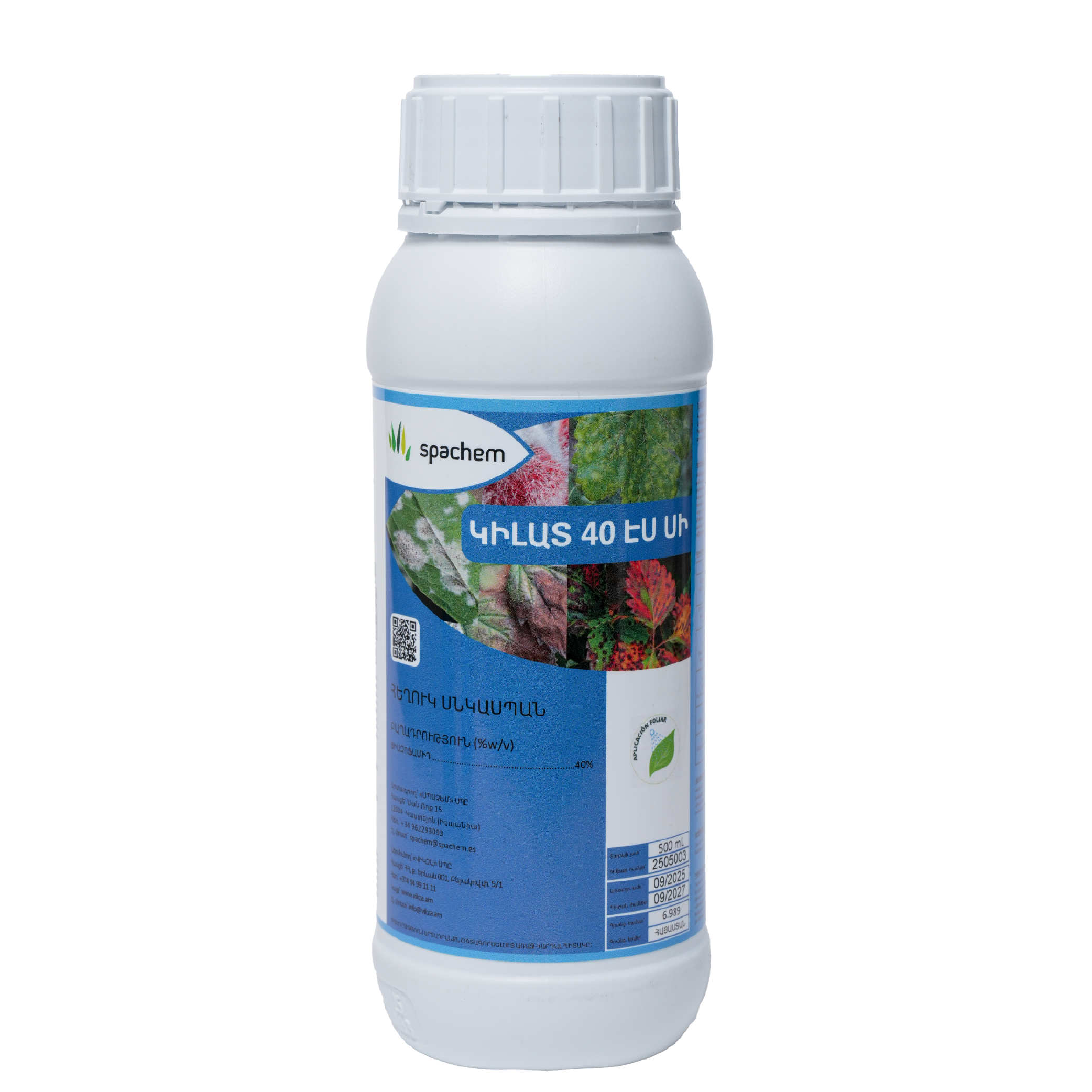
100ml, 250ml, 500ml, 1L, 5L, 10L, 20L, 200L, 1000L

Preventive contact fungicide belonging to the group of sulfonamides, with preventive and protective, translaminar and antisporulant action. Prevents the development of all stages of the biological cycle of Phytophthora infestans (potato and tomato mildew), Pseudoperonospora cubensis (melon, cucumber and other cucurbits mildew) and other mildews from the formation of zoosporangia and germination of zoospores to the mycelium growth, presented in the form of a concentrated suspension to be applied as a foliar spray.
| CROPS | PLAGUE | DOSE (L/Ha) |
|---|---|---|
| Vegetables (tomato, pepper, chili, eggplant, potato, carrot, zucchini) | Mildew (Mildiu) |
0.2 - 0.25 |
| Vegetables (tomato, pepper, chili, eggplant, potato, carrot, zucchini) | Black scurf or rhizoctonia (Rhizoctonia solani) |
0.4 - 0.5 |
| Vegetables (tomato, pepper, chili, eggplant, potato, carrot, zucchini) | Carrot white rot (Sclerotinia Libertiana) |
0.4 - 0.6 |
| Vegetables (tomato, pepper, chili, eggplant, potato, carrot, zucchini) | Tomato fake powdery mildew (Phytophthora infestans) |
0.4 - 0.6 |
| Vegetables (tomato, pepper, chili, eggplant, potato, carrot, zucchini) | Potato phytophthora (Phytophthora infestans) |
0.4 - 0.5 |
| Vegetables (tomato, pepper, chili, eggplant, potato, carrot, zucchini) | Powdery mildew (Phytophthora spp) |
0.2 - 0.25 |
| Vegetables (tomato, pepper, chili, eggplant, potato, carrot, zucchini) | Faba bean fusarium wilt (Fusarium oxysporum) |
0.4 - 0.6 |
| Edible leaf crops (cabbage, lettuce, broccoli, spinach) | Mildew (Mildiu) |
0.2 - 0.25 |
| Edible leaf crops (cabbage, lettuce, broccoli, spinach) | Powdery mildew (Phytophthora spp) |
0.2 - 0.25 |
| Edible leaf crops (cabbage, lettuce, broccoli, spinach) | Black leg of cabbage seedlings (Opidium brassicae) |
0.4 - 0.6 |
| Liliaceas and other crucifera (garlic, onion, asparagus, turnip, radishes) | Black leg of cabbage seedlings (Opidium brassicae) |
0.4 - 0.6 |
| Extensive and industrial (wheat, corn, barley, tabaci, beet) | Powdery mildew of cereals (Erysiphe graminis) |
0.4 - 0.6 |
| Extensive and industrial (wheat, corn, barley, tabaci, beet) | Tobacco fake powdery mildew (Peronospora tabacina) |
0.4 - 0.6 |
| Extensive and industrial (wheat, corn, barley, tabaci, beet) | Sunflower fake powdery mildew (Plasmopara Halstedii) |
0.4 - 0.6 Curative |
| Extensive and industrial (wheat, corn, barley, tabaci, beet) | Black scurf or rhizoctonia (Rhizoctonia solani) |
0.4 - 0.5 |
| Extensive and industrial (wheat, corn, barley, tabaci, beet) | Sclerotinia (Sclerotinia graminearum) |
0.4 - 0.6 |
| Berries (strawberry, raspberry, blueberry, blackberries, currant, vine) | Fake downy mildew of grapes (Plasmopara viticola) |
0.4 - 0.6 Curative |
| Berries (strawberry, raspberry, blueberry, blackberries, currant, vine) | Powdery mildew of strawberry (Sphaerotheca macularis f. fragariae) |
0.4 - 0.6 |
| Cucurbitaceas (melon, watermelon, pumpkin) | Mildew (Mildiu) |
0.2 - 0.25 |
| Cucurbitaceas (melon, watermelon, pumpkin) | Fake downy mildew of cucurbits (Pseudoperonospora cubensis) |
0.4 - 0.6 |
| Cucurbitaceas (melon, watermelon, pumpkin) | Powdery mildew (Phytophthora spp) |
0.2 - 0.25 |
| Legumes (beans, peas, lentils) | Black leaf spot of alfalfa (Pseudopeziza medicaginis) |
0.4 - 0.6 |
Kilat 40 SC
Preventive contact fungicide belonging to the group of sulfonamides, with preventive and protective, translaminar and antisporulant action. Prevents the development of all stages of the biological cycle of Phytophthora infestans (potato and tomato mildew), Pseudoperonospora cubensis (melon, cucumber and other cucurbits mildew) and other mildews from the formation of zoosporangia and germination of zoospores to the mycelium growth, presented in the form of a concentrated suspension to be applied as a foliar spray.
- Cyazofamid 40.0 %
INTERVAL BETWEEN LAST APPLICATION AND HARVEST (WAITING PERIOD)
12 h.
MAXIMUM NUMBER OF TREATMENTS
Without restriction.
Apply every 7 to 14 days depending on the severity of the infestation.
Regulate the pH.
The effectivenes of treatments are provided by a complete follage wettiness and use of adjuvant.
For tomatoes and potatoes, it is suggested not to make more than 2 consecutive applications during the crop cycle. For pumpkin, zucchini, melon and cucumber, do not make more than 4 consecutive applications during the crop cycle.
The application of the product can be carried out with ground equipment (motorized backpack pumps, equipped with a centrifugal pump and rotating terminals) and aerial equipment (aircraft or helicopters equipped with “micronaires” or controlled drop devices). Use nozzles that allow you to obtain a minimum drop density of 50-70 drops/cm2.
The volume of water to use depends on the crop and size of the plant. It is recommended to use a minimum water volume of 400 L/ha or more, in order to obtain uniform coverage of the foliage of the crop according to its size, without running off. With volumes greater than 600 L/ha, the use of an adjuvant is not necessary. It should be applied with a non-ionic organosilicon adjuvant at a dose of 0.05% v/v equivalent to 0.5 mL/L for tomatoes and potatoes, and 0.03% v/v equivalent to 0.3 mL/L of water in the case of pumpkin. zucchini, melon and cucumber.
Do not carry out mechanized land applications in extensive crops (oilseed and forage cereals) at a distance of less than 300 meters from any urban or suburban area and population center. If using aerial applications, use a minimum water volume of 20 liters/ha. Do not carry out aerial applications at a distance of less than 500 m from any urban or suburban area and population center. Do not apply during hours of intense heat > 30 oC and the relative humidity is less than 50%, when there are winds with speeds greater than 10 km/h, or in the presence of rain. Apply preferably in the morning or afternoon.
Before starting any treatment, it is recommended that you always calibrate your application equipment, in order to obtain a sufficient volume of water to evenly cover all the foliage of the plant. Always calibrate your equipment with water only before applying product. Remember to obtain the appropriate auxiliary equipment (solid and liquid meters, graduated cuvettes, stirring paddles, brushes, etc.). Keep the agitation system moving at all times.
Avoid overlapping stripes during spraying. Apply away from springs, courses or water sources.
KILAT 40 SC is incompatible with alkaline reaction products. The product is compatible with many other fungicides when used at normal rates. However, a compatibility test is recommended before use with other products. Do not directly mix the concentrate with other concentrated herbicides or pesticides, always dilute it first.
PHYTOTOXICITYIt is not phytotoxic when used according to the recommendations and doses of SPACHEM S.L. In case of mixing, perform a small scale test to check compatibility and phytotoxicity.
REMARKS
The recommendations and information we provide are the result of extensive and rigorous studies and tests, however, numerous factors beyond our control may intervene in the use (preparation of mixtures, application, weather, etc.). The company guarantees the composition, formulation and content. The user will be liable for any damage caused ( lack of efficacy, general toxicity, residues, etc.) due to total or partial non-observance of the label instructions.
- Verify the correct calibration of the equipment before starting the application
- Put water halfway up the tank of the applicator equipment, add the necessary amount of KILAT 40 SC product according to the dose recommended on this label, keeping the shaker running and top up with the rest of the volume of water.
- It is recommended to add a non-ionic adjuvant to improve coverage.
- Before starting any treatment, it is essential to verify the correct calibration of the equipment and the proper functioning of the nozzles (filters and pads), replacing the defective parts.
- Do not perform applications with high temperatures.
- Apply away from springs, courses, or fountains.
- Always calibrate your equipment with water only before applying the product.
- Remember to get the right auxiliary equipment (solid and liquid product meters), graduated trays, stirring paddles, brushes, brushes, etc.
- Use the following protective equipment for mixing, loading, and applying: boots, mask, goggles, gloves, and dispenser.
The icon identifies products designed for direct application to leaves, where nutrients and biostimulants are rapidly absorbed through the stomatal and cuticular pathways.