


Koppar 27 SC
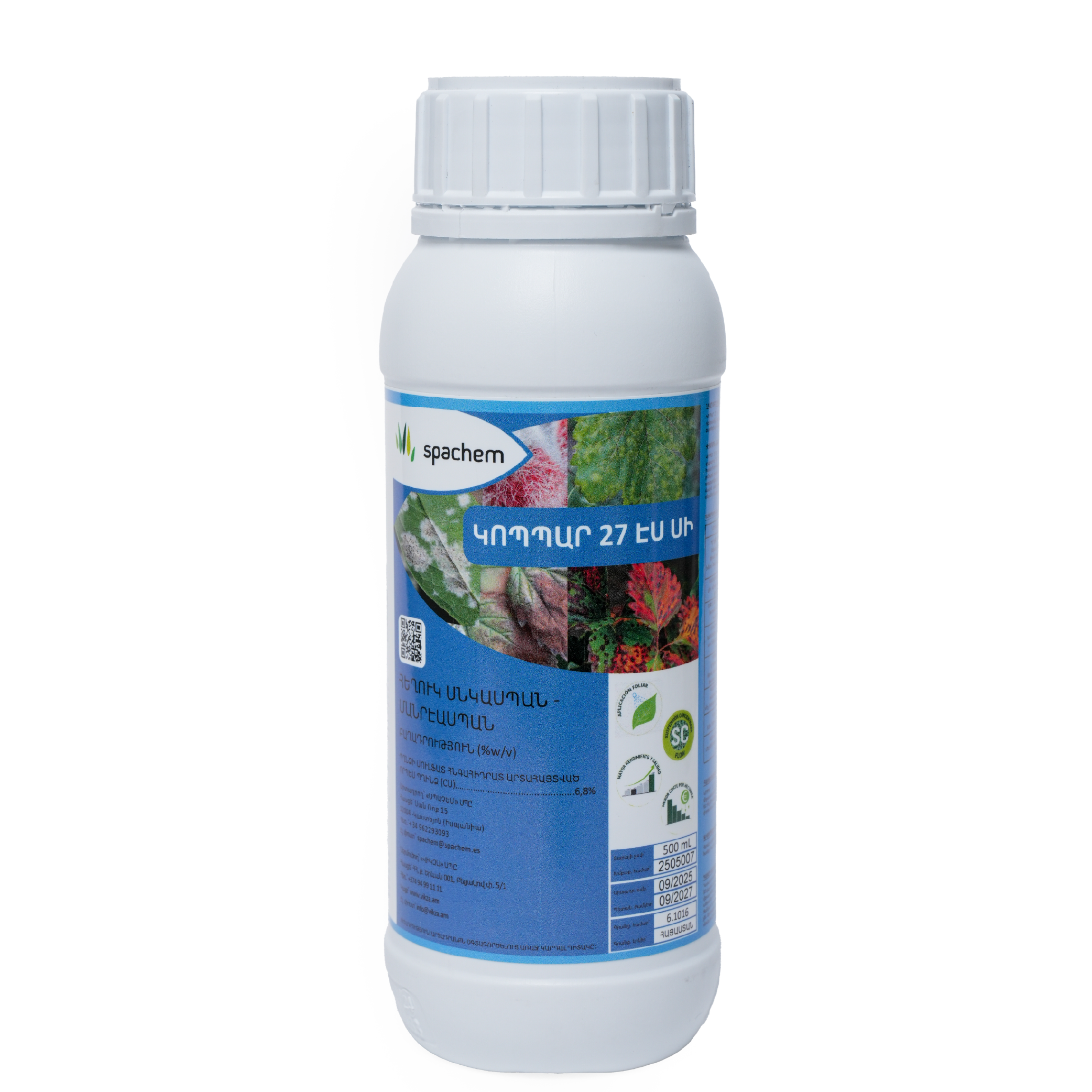
100ml, 250ml, 500ml, 1L, 5L, 10L, 20L, 200L, 1000L



KOPPAR 27 SC is a systemic bactericide and fungicide, with preventive and curative action against a wide range of bacterial and fungal diseases affecting ornamental crops, fruit trees, vegetables and various extensive crops.
| CROPS | PLAGUE | DOSE (L/Ha) |
|---|---|---|
| Fruit trees (peach, nectarine, plum, cherry, apricot, kumquat, pear, apple, pomegranate, persimmon, fig etc.) | He diseases caused (Diaporthe spp) |
2 - 3 |
| Fruit trees (peach, nectarine, plum, cherry, apricot, kumquat, pear, apple, pomegranate, persimmon, fig etc.) | Fire blight of fruit crops (Erwinia amylovora) |
1.5 - 2.0 |
| Fruit trees (peach, nectarine, plum, cherry, apricot, kumquat, pear, apple, pomegranate, persimmon, fig etc.) | Peach leaf curl (Exoascus deformans) |
1.5 - 2.0 |
| Fruit trees (peach, nectarine, plum, cherry, apricot, kumquat, pear, apple, pomegranate, persimmon, fig etc.) | Plum pockets (Exoascus pruni) |
1.5 - 2.0 |
| Fruit trees (peach, nectarine, plum, cherry, apricot, kumquat, pear, apple, pomegranate, persimmon, fig etc.) | Pear rust (Gymnosporangium sabinae) |
1.5 - 2.0 |
| Fruit trees (peach, nectarine, plum, cherry, apricot, kumquat, pear, apple, pomegranate, persimmon, fig etc.) | Apple rust (Gymnosporangium tremelloides) |
1.5 - 2.0 |
| Fruit trees (peach, nectarine, plum, cherry, apricot, kumquat, pear, apple, pomegranate, persimmon, fig etc.) | Red burn of plums (Polystigma rubrum) |
1.5 - 2.0 |
| Fruit trees (peach, nectarine, plum, cherry, apricot, kumquat, pear, apple, pomegranate, persimmon, fig etc.) | White pear leaf spot (Septoria piricola) |
1.5 - 2.0 |
| Fruit trees (peach, nectarine, plum, cherry, apricot, kumquat, pear, apple, pomegranate, persimmon, fig etc.) | Black cancer (Sphaeropsis malorum) |
1.5 - 2.0 |
| Fruit trees (peach, nectarine, plum, cherry, apricot, kumquat, pear, apple, pomegranate, persimmon, fig etc.) | Apple scab (Venturia inaequalis) |
1.5 - 2.0 |
| Fruit trees (peach, nectarine, plum, cherry, apricot, kumquat, pear, apple, pomegranate, persimmon, fig etc.) | Pear scab (Venturia pyrina) |
1.5 - 2.0 |
| Fruit trees (peach, nectarine, plum, cherry, apricot, kumquat, pear, apple, pomegranate, persimmon, fig etc.) | Anthracnose |
2 - 3 |
| Fruit trees (peach, nectarine, plum, cherry, apricot, kumquat, pear, apple, pomegranate, persimmon, fig etc.) | Spot (Mycosphaerella spp) |
2 - 3 |
| Fruit trees (peach, nectarine, plum, cherry, apricot, kumquat, pear, apple, pomegranate, persimmon, fig etc.) | Scurf (Elsinoe spp) |
2 - 3 |
| Fruit trees (peach, nectarine, plum, cherry, apricot, kumquat, pear, apple, pomegranate, persimmon, fig etc.) | Powdery mildew (Phytophthora spp) |
2 - 3 |
| Vegetables (tomato, pepper, chili, eggplant, potato, carrot, zucchini) | Powdery mildew (Phytophthora spp) |
0.75 - 1.5 |
| Vegetables (tomato, pepper, chili, eggplant, potato, carrot, zucchini) | Cucumber bacteriosis (Pseudomonas lachrymans) |
2.0 Replanting |
| Vegetables (tomato, pepper, chili, eggplant, potato, carrot, zucchini) | Potato cancer (Synchytrium endobioticum) |
1.5 - 2.0 Preventive |
| Vegetables (tomato, pepper, chili, eggplant, potato, carrot, zucchini) | Potato ring rot (Corynebacterium sepedonicum) |
1.5 - 2.0 Preventive |
| Edible leaf crops (cabbage, lettuce, broccoli, spinach) | Leaf spot |
1 - 1.5 |
| Edible leaf crops (cabbage, lettuce, broccoli, spinach) | Cabbage keela (Plasmodiophora brassicae) |
2.0 Replanting |
| Liliaceas and other crucifera (garlic, onion, asparagus, turnip, radishes) | Rot (Alternaria spp) |
1 - 1.5 |
| Extensive and industrial (wheat, corn, barley, tabaci, beet) | Anthracnose |
0.5 - 1 |
| Extensive and industrial (wheat, corn, barley, tabaci, beet) | Purple ergot (Claviceps purpurea) |
0.75 - 1.0 |
| Extensive and industrial (wheat, corn, barley, tabaci, beet) | Oat crown rust (Puccinia coronifera) |
1 - 3 |
| Extensive and industrial (wheat, corn, barley, tabaci, beet) | Wheat yellow rust (Puccinia glumarum) |
1 - 3 |
| Extensive and industrial (wheat, corn, barley, tabaci, beet) | Stem or linear rust (Puccinia graminis) |
1 - 3 |
| Extensive and industrial (wheat, corn, barley, tabaci, beet) | Dwarf leaf rust of barley (Puccinia hordei) |
1 - 3 |
| Extensive and industrial (wheat, corn, barley, tabaci, beet) | Rust of maize (Puccinia maydis) |
1 - 3 |
| Extensive and industrial (wheat, corn, barley, tabaci, beet) | Barley rust (Puccinia simplex) |
1 - 3 |
| Extensive and industrial (wheat, corn, barley, tabaci, beet) | Wheat leaf brown rust (Puccinia triticina) |
1 - 3 |
| Extensive and industrial (wheat, corn, barley, tabaci, beet) | Bacterial blight of cotton (Xanthomonas malvacearum) |
1.5 |
| Berries (strawberry, raspberry, blueberry, blackberries, currant, vine) | Fake powdery mildew (Plasmopara spp) |
1 - 1.5 |
| Berries (strawberry, raspberry, blueberry, blackberries, currant, vine) | Mulberry rust (Phragmidium rubi) |
0.75 - 1 |
| Berries (strawberry, raspberry, blueberry, blackberries, currant, vine) | Fake downy mildew of grapes (Plasmopara viticola) |
0.75 - 1.0 |
| Berries (strawberry, raspberry, blueberry, blackberries, currant, vine) | Currant rust (Puccinia ribis) |
2 - 2.5 |
| Berries (strawberry, raspberry, blueberry, blackberries, currant, vine) | Grey mould (Botrytis spp) |
1 - 1.5 |
| Cucurbitaceas (melon, watermelon, pumpkin) | Powdery mildew (Erysiphe spp) |
0.75 - 1.5 |
| Cucurbitaceas (melon, watermelon, pumpkin) | Cucumber bacteriosis (Pseudomonas lachrymans) |
2.0 Replanting |
| Cucurbitaceas (melon, watermelon, pumpkin) | Fake downy mildew of cucurbits (Pseudoperonospora cubensis) |
2.0 Replanting |
| Aromatic and ornamental (cilantro, parsley, mint, sage, rosemary, thyme, tarragon, rose, gerberas, thuja, fir tree, carnations) | For fungal diseases |
0.75 - 1 Preventive, only ornamental and coniferous plants |
| Legumes (beans, peas, lentils) | Bacterial blight of bean (Xanthomonas phaseoli) |
1.5 - 2.0 |
Koppar 27 SC
KOPPAR 27 SC is a systemic bactericide and fungicide, with preventive and curative action against a wide range of bacterial and fungal diseases affecting ornamental crops, fruit trees, vegetables and various extensive crops.
- Copper sulfate pentahydrate expressed as Copper (Cu) 6.8 %
INTERVAL BETWEEN LAST APPLICATION AND HARVEST (WAITING PERIOD)
12 h.
MAXIMUM NUMBER OF TREATMENTS
Without restriction․
The frequency of application depends on the severity of the disease and environmental conditions. Generally, it is recommended to apply every 10-14 days or as needed based on disease pressure.
Regulate the pH.
The effectivenes of treatments are provided by a complete follage wettiness and use of adjuvant.
Due to the patented manufacturing process, the systemic action of KOPPAR 27 SC in plants is made possible. This process causes the copper sulfate pentahydrate to be absorbed systemically in the plant and "protects the inside" against bacteria and fungal diseases. In conventional copper fungicides, the active ingredient stays out of the plants as a "protectant."
Due to the systemic effects of KOPPAR 27 SC, the amount of copper going into the environment is reduced by 98% compared to the use of conventional copper fungicides.
KOPPAR 27 SC has been effectively used for the control of 150 diseases (bacteria and fungi) in more than 145 crops worldwide, such as ornamentals, vegetables, cereals, vines, fruit trees, citrus fruits, forests, export crops such as coffee, banana, sugar cane, banana, avocado, mango, papaya, coffee, etc...
REMARKS
Observe the precautions for the phytotoxicity of Copper, especially in cold and humid areas, in some varieties of fruit trees, vines and other crops.
KOPPAR 27 SC can be used just as often with other pesticides in a Pest Management (every 5‐7 days). To improve and maximize the performance of the KOPPAR 27 SC, it is recommended to first add a Indicator Plus 5 pH Regulator Adjuvant to Mixing Tanks to Improve Mixing Rate quality of the water spray solution and then add the recommended rate of KOPPAR 27 SC to the tank mixture.
COMPATIBILITYKOPPAR 27 SC is chemically compatible with most insecticides, fungicides, etc., used in agriculture, except those with a marked acid or alkaline action. As for physical compatibility, in case of doubt it is recommended to carry out a prior test.
PHYTOTOXICITYFollow copper phytotoxicity precautions, especially when using with fruit trees, grapes, and other crops in cold and humid conditions. Upon preparation of a mixture, a small-scale test should be conducted to check compatibility and phytotoxicity.
REMARKS
The recommendations and information we provide are the result of extensive and rigorous studies and tests, however, numerous factors beyond our control may intervene in the use (preparation of mixtures, application, weather, etc.). The company guarantees the composition, formulation and content. The user will be liable for any damage caused ( lack of efficacy, general toxicity, residues, etc.) due to total or partial non-observance of the label instructions.
- Verify the correct calibration of the equipment before starting the application
- Put water halfway up the tank of the applicator equipment, add the necessary amount of KOPPAR 27 SC product according to the dose recommended on this label, keeping the shaker running and top up with the rest of the volume of water.
- It is recommended to add a non-ionic adjuvant to improve coverage.
- Before starting any treatment, it is essential to verify the correct calibration of the equipment and the proper functioning of the nozzles (filters and pads), replacing the defective parts.
- Do not perform applications with high temperatures.
- Apply away from springs, courses, or fountains.
- Always calibrate your equipment with water only before applying the product.
- Remember to get the right auxiliary equipment (solid and liquid product meters), graduated trays, stirring paddles, brushes, brushes, etc.
- Use the following protective equipment for mixing, loading, and applying: boots, mask, goggles, gloves, and dispenser.
The icon refers to a suspension concentrate (SC). This is a liquid formulation containing a solid, insoluble active ingredient dispersed in water as very fine particles less than 10 microns. It is diluted in water for application, offering advantages such as easy handling, reduced dust, high efficacy, and good dispersion in water.
The icon communicates that the product is formulated to maximize productivity and improve the commercial quality of the crop.
The icon highlights fertilizers with high agronomic and economic efficiency.
The icon identifies products designed for direct application to leaves, where nutrients and biostimulants are rapidly absorbed through the stomatal and cuticular pathways.