


Platinum Flow
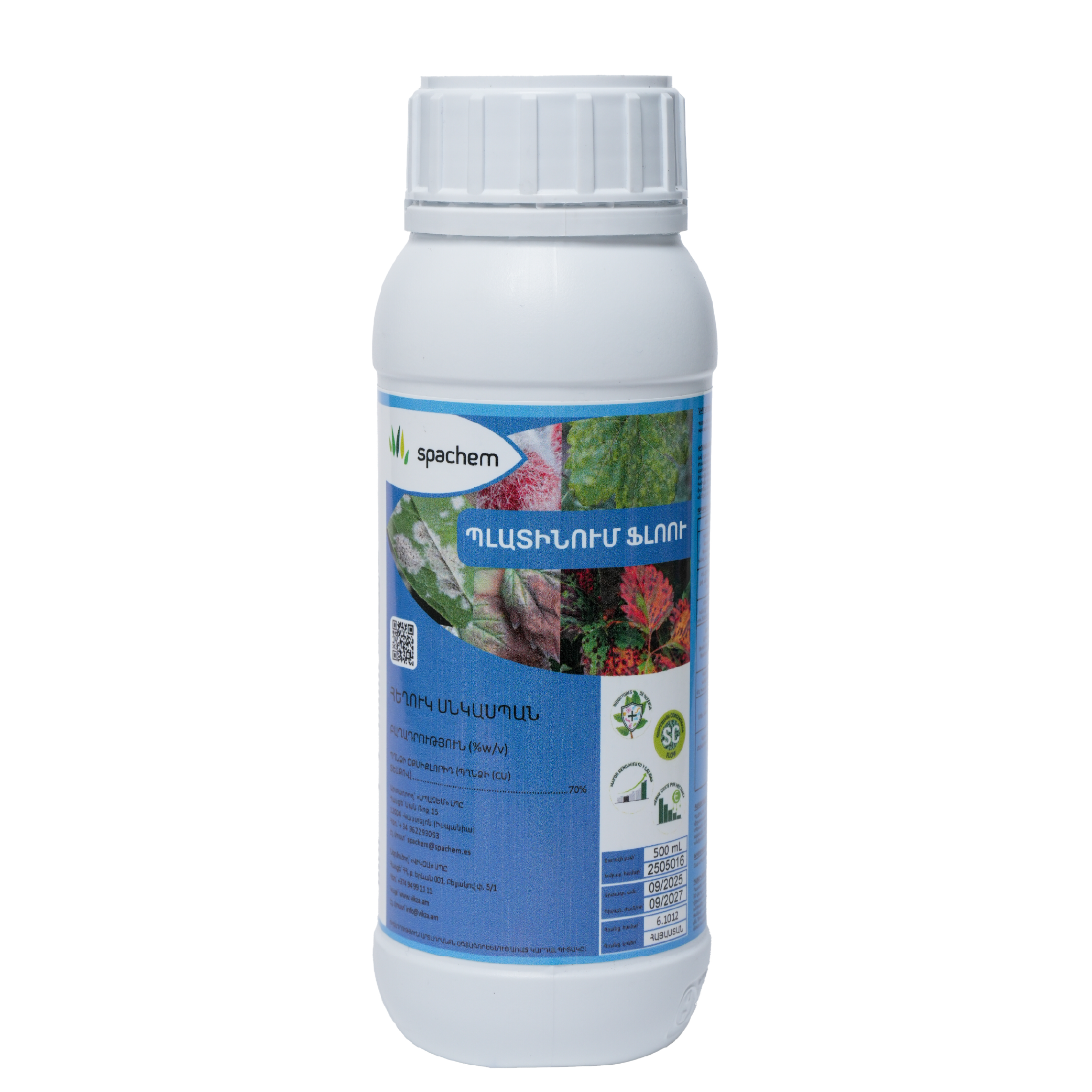
100ml, 250ml, 500ml, 1L, 5L, 10L, 20L, 200L, 1000L






PLATINUM FLOW is a concentrated suspension of copper of fungicidal and bactericidal action for an application in the agricultural crops and plantations mentioned below.
Normal spray treatments:
| CROPS | PLAGUE | DOSE (L/Ha) |
|---|---|---|
| Fruit trees (peach, nectarine, plum, cherry, apricot, kumquat, pear, apple, pomegranate, persimmon, fig etc.) | He diseases caused (Diaporthe spp) |
1.5 - 3 |
| Fruit trees (peach, nectarine, plum, cherry, apricot, kumquat, pear, apple, pomegranate, persimmon, fig etc.) | Shot hole disease of stone fruits (Clasterosporium carpophilum) |
1 - 1.5 |
| Fruit trees (peach, nectarine, plum, cherry, apricot, kumquat, pear, apple, pomegranate, persimmon, fig etc.) | Fire blight of fruit crops (Erwinia amylovora) |
2.0 - 2.5 Preventive |
| Fruit trees (peach, nectarine, plum, cherry, apricot, kumquat, pear, apple, pomegranate, persimmon, fig etc.) | Peach leaf curl (Exoascus deformans) |
1 - 1.5 |
| Fruit trees (peach, nectarine, plum, cherry, apricot, kumquat, pear, apple, pomegranate, persimmon, fig etc.) | Plum pockets (Exoascus pruni) |
1 - 1.5 |
| Fruit trees (peach, nectarine, plum, cherry, apricot, kumquat, pear, apple, pomegranate, persimmon, fig etc.) | Pear rust (Gymnosporangium sabinae) |
1 - 1.5 |
| Fruit trees (peach, nectarine, plum, cherry, apricot, kumquat, pear, apple, pomegranate, persimmon, fig etc.) | Apple rust (Gymnosporangium tremelloides) |
1 - 1.5 |
| Fruit trees (peach, nectarine, plum, cherry, apricot, kumquat, pear, apple, pomegranate, persimmon, fig etc.) | Fruit rot (Monilia fructigena) |
1 - 2 |
| Fruit trees (peach, nectarine, plum, cherry, apricot, kumquat, pear, apple, pomegranate, persimmon, fig etc.) | Red burn of plums (Polystigma rubrum) |
1 - 1.5 |
| Fruit trees (peach, nectarine, plum, cherry, apricot, kumquat, pear, apple, pomegranate, persimmon, fig etc.) | White pear leaf spot (Septoria piricola) |
1 - 1.5 |
| Fruit trees (peach, nectarine, plum, cherry, apricot, kumquat, pear, apple, pomegranate, persimmon, fig etc.) | Black cancer (Sphaeropsis malorum) |
1 - 1.5 |
| Fruit trees (peach, nectarine, plum, cherry, apricot, kumquat, pear, apple, pomegranate, persimmon, fig etc.) | Apple scab (Venturia inaequalis) |
1 - 1.5 |
| Fruit trees (peach, nectarine, plum, cherry, apricot, kumquat, pear, apple, pomegranate, persimmon, fig etc.) | Pear scab (Venturia pyrina) |
1 - 1.5 |
| Fruit trees (peach, nectarine, plum, cherry, apricot, kumquat, pear, apple, pomegranate, persimmon, fig etc.) | Spot (Mycosphaerella spp) |
1 - 1.5 |
| Fruit trees (peach, nectarine, plum, cherry, apricot, kumquat, pear, apple, pomegranate, persimmon, fig etc.) | Anthracnose (Colletotrichum spp) |
1 - 1.5 |
| Fruit trees (peach, nectarine, plum, cherry, apricot, kumquat, pear, apple, pomegranate, persimmon, fig etc.) | Scurf (Elsinoe spp) |
1.5 - 3 |
| Fruit trees (peach, nectarine, plum, cherry, apricot, kumquat, pear, apple, pomegranate, persimmon, fig etc.) | Scurf (Elsinoe spp) |
1.5 - 3 |
| Fruit trees (peach, nectarine, plum, cherry, apricot, kumquat, pear, apple, pomegranate, persimmon, fig etc.) | Bacterial (Xanthomonas spp) |
1.5 - 3 |
| Fruit trees (peach, nectarine, plum, cherry, apricot, kumquat, pear, apple, pomegranate, persimmon, fig etc.) | Powdery mildew (Phytophthora spp) |
1.5 - 3 |
| Vegetables (tomato, pepper, chili, eggplant, potato, carrot, zucchini) | Powdery mildew (Phytophthora spp) |
1 - 1.2 |
| Vegetables (tomato, pepper, chili, eggplant, potato, carrot, zucchini) | Rot (Alternaria spp) |
0.75 - 1.5 |
| Vegetables (tomato, pepper, chili, eggplant, potato, carrot, zucchini) | Potato common scab (Actinomyces scabies) |
2.0 - 2.5 Pre-planting |
| Vegetables (tomato, pepper, chili, eggplant, potato, carrot, zucchini) | Carrot black rot (Alternaria radicina) |
0.75 - 1.5 |
| Vegetables (tomato, pepper, chili, eggplant, potato, carrot, zucchini) | Potato brown leaf spot (Cercospora concors) |
1.5 - 3.0 |
| Vegetables (tomato, pepper, chili, eggplant, potato, carrot, zucchini) | Potato ring rot (Corynebacterium sepedonicum) |
1 - 1.5 |
| Vegetables (tomato, pepper, chili, eggplant, potato, carrot, zucchini) | Cucumber bacteriosis (Pseudomonas lachrymans) |
0.75 - 1.5 Preventive |
| Vegetables (tomato, pepper, chili, eggplant, potato, carrot, zucchini) | Watery wound rot of potato (Pseudomonas xanthochlora) |
1 - 1.5 |
| Vegetables (tomato, pepper, chili, eggplant, potato, carrot, zucchini) | Carrot white rot (Sclerotinia Libertiana) |
1 - 1.5 |
| Vegetables (tomato, pepper, chili, eggplant, potato, carrot, zucchini) | Tomato Septoria (Septoria lycopersici) |
0.75 - 1.5 |
| Vegetables (tomato, pepper, chili, eggplant, potato, carrot, zucchini) | Powdery scab of potatoes (Spongospora subterranea) |
1 - 1.5 Preventive |
| Vegetables (tomato, pepper, chili, eggplant, potato, carrot, zucchini) | Potato cancer (Synchytrium endobioticum) |
1 - 1.5 Preventive |
| Vegetables (tomato, pepper, chili, eggplant, potato, carrot, zucchini) | Tomato fake powdery mildew (Phytophthora infestans) |
1 - 1.2 Preventive |
| Vegetables (tomato, pepper, chili, eggplant, potato, carrot, zucchini) | Potato phytophthora (Phytophthora infestans) |
1.5 - 3.0 |
| Vegetables (tomato, pepper, chili, eggplant, potato, carrot, zucchini) | Bacterial (Pseudomonas spp) |
0.75 - 1.5 |
| Vegetables (tomato, pepper, chili, eggplant, potato, carrot, zucchini) | Rust (Uromyces spp) |
0.75 - 1.5 |
| Vegetables (tomato, pepper, chili, eggplant, potato, carrot, zucchini) | Anthracnose |
0.75 - 1.5 |
| Edible leaf crops (cabbage, lettuce, broccoli, spinach) | Cabbage keela (Plasmodiophora brassicae) |
2.5 - 3.0 Soil disinfection |
| Liliaceas and other crucifera (garlic, onion, asparagus, turnip, radishes) | Powdery mildew (Phytophthora spp) |
1 - 1.2 |
| Liliaceas and other crucifera (garlic, onion, asparagus, turnip, radishes) | Rot (Alternaria spp) |
0.75 - 1.5 |
| Liliaceas and other crucifera (garlic, onion, asparagus, turnip, radishes) | Bacterial (Pseudomonas spp) |
0.75 - 1.5 |
| Liliaceas and other crucifera (garlic, onion, asparagus, turnip, radishes) | Rust (Uromyces spp) |
0.75 - 1.5 |
| Liliaceas and other crucifera (garlic, onion, asparagus, turnip, radishes) | Anthracnose |
0.75 - 1.5 |
| Extensive and industrial (wheat, corn, barley, tabaci, beet) | Spot of rice (Pyricularia spp) |
0.75 - 1.5 |
| Extensive and industrial (wheat, corn, barley, tabaci, beet) | Black rot (Stemphylium spp) |
0.4 |
| Extensive and industrial (wheat, corn, barley, tabaci, beet) | Purple ergot (Claviceps purpurea) |
1.0 - 1.5 Preventive |
| Extensive and industrial (wheat, corn, barley, tabaci, beet) | Dry rot of maize (Diplodia zeae) |
1.0 - 1.5 Preventive |
| Extensive and industrial (wheat, corn, barley, tabaci, beet) | Tobacco fake powdery mildew (Peronospora tabacina) |
1.5 - 1.75 |
| Extensive and industrial (wheat, corn, barley, tabaci, beet) | Sunflower fake powdery mildew (Plasmopara Halstedii) |
1.5 - 3.0 |
| Extensive and industrial (wheat, corn, barley, tabaci, beet) | Oat crown rust (Puccinia coronifera) |
0.75 - 1 |
| Extensive and industrial (wheat, corn, barley, tabaci, beet) | Wheat yellow rust (Puccinia glumarum) |
0.75 - 1 |
| Extensive and industrial (wheat, corn, barley, tabaci, beet) | Stem or linear rust (Puccinia graminis) |
0.75 - 1 |
| Extensive and industrial (wheat, corn, barley, tabaci, beet) | Sunflower rust (Puccinia helianthi) |
1.5 - 3.0 |
| Extensive and industrial (wheat, corn, barley, tabaci, beet) | Dwarf leaf rust of barley (Puccinia hordei) |
0.75 - 1 |
| Extensive and industrial (wheat, corn, barley, tabaci, beet) | Rust of maize (Puccinia maydis) |
0.75 - 1 |
| Extensive and industrial (wheat, corn, barley, tabaci, beet) | Barley rust (Puccinia simplex) |
0.75 - 1 |
| Extensive and industrial (wheat, corn, barley, tabaci, beet) | Wheat leaf brown rust (Puccinia triticina) |
0.75 - 1 |
| Extensive and industrial (wheat, corn, barley, tabaci, beet) | Bacterial blight of cotton (Xanthomonas malvacearum) |
1 - 3 |
| Extensive and industrial (wheat, corn, barley, tabaci, beet) | Bacterial (Xanthomonas spp) |
0.75 - 1.5 |
| Extensive and industrial (wheat, corn, barley, tabaci, beet) | Black scurf (Rhizoctonia spp) |
0.75 - 1.5 |
| Berries (strawberry, raspberry, blueberry, blackberries, currant, vine) | Fake powdery mildew (Plasmopara spp) |
1.2 - 2 |
| Berries (strawberry, raspberry, blueberry, blackberries, currant, vine) | Gray mold of grapes (Botrytis cinerea) |
1.0 - 2.0 |
| Berries (strawberry, raspberry, blueberry, blackberries, currant, vine) | Anthracnose of currant (Gloesporium ribis) |
1.5 - 2.0 |
| Berries (strawberry, raspberry, blueberry, blackberries, currant, vine) | Mulberry rust (Phragmidium rubi) |
1.5 - 2.0 Preventive, sporogenesis |
| Berries (strawberry, raspberry, blueberry, blackberries, currant, vine) | Fake downy mildew of grapes (Plasmopara viticola) |
1.2 - 2.0 Preventive |
| Berries (strawberry, raspberry, blueberry, blackberries, currant, vine) | Currant rust (Puccinia ribis) |
1.5 - 3.0 |
| Berries (strawberry, raspberry, blueberry, blackberries, currant, vine) | Strawberry white spot (Ramularia tulasnei) |
1 - 1.5 |
| Berries (strawberry, raspberry, blueberry, blackberries, currant, vine) | Black rot of blackberries (Rhizopus nigricans) |
1.5 - 2.0 Preventive, sporogenesis |
| Cucurbitaceas (melon, watermelon, pumpkin) | Powdery mildew (Phytophthora spp) |
1 - 1.2 |
| Cucurbitaceas (melon, watermelon, pumpkin) | Rot (Alternaria spp) |
0.75 - 1.5 |
| Cucurbitaceas (melon, watermelon, pumpkin) | Anthracnose of cucurbits (Colletotrichum lagenarium) |
1.0 - 1.5 Pre-flowering and fruit set |
| Cucurbitaceas (melon, watermelon, pumpkin) | Cucumber bacteriosis (Pseudomonas lachrymans) |
0.75 - 1.5 Preventive |
| Cucurbitaceas (melon, watermelon, pumpkin) | Fake downy mildew of cucurbits (Pseudoperonospora cubensis) |
2.5 - 3.0 |
| Cucurbitaceas (melon, watermelon, pumpkin) | Bacterial (Pseudomonas spp) |
0.75 - 1.5 |
| Cucurbitaceas (melon, watermelon, pumpkin) | Rust (Uromyces spp) |
0.75 - 1.5 |
| Cucurbitaceas (melon, watermelon, pumpkin) | Anthracnose |
0.75 - 1.5 |
| Legumes (beans, peas, lentils) | Ascochyta blight of Alfalfa (Ascochyta imperfecta) |
1.5 - 3.0 |
| Legumes (beans, peas, lentils) | Ascochyta blight of sainfoin (Ascochyta onobrychis) |
1.5 - 3.0 |
| Legumes (beans, peas, lentils) | Ascochyta blight of pea (Ascochyta pisi) |
1.5 - 3.0 |
| Legumes (beans, peas, lentils) | Bean anthracnose (Colletotrichum lindemuthianum) |
0.75 - 1.5 |
| Legumes (beans, peas, lentils) | Clover anthracnose (Kabatiella caulivora) |
1 - 2 |
| Legumes (beans, peas, lentils) | Black leaf spot of alfalfa (Pseudopeziza medicaginis) |
1 - 2 |
| Legumes (beans, peas, lentils) | Faba bean rust (Uromyces fabae) |
1.5 - 3.0 |
| Legumes (beans, peas, lentils) | Clover rust (Uromyces fallens) |
1.5 - 3.0 |
| Legumes (beans, peas, lentils) | Bean rust (Uromyces phaseoli) |
1.5 - 3.0 |
| Legumes (beans, peas, lentils) | Pea rust (Uromyces pisi) |
1.5 - 3.0 |
| Legumes (beans, peas, lentils) | Alfalfa rust (Uromyces striatus) |
1.5 - 3.0 |
| Legumes (beans, peas, lentils) | Bacterial blight of bean (Xanthomonas phaseoli) |
1 - 1.5 |
| Legumes (beans, peas, lentils) | Sainfoin rust (Uromyces onobrychidis) |
1.5 - 3.0 |
| Legumes (beans, peas, lentils) | Anthracnose |
1 - 1.5 |
| Legumes (beans, peas, lentils) | Mildew (Mildiu) |
1 - 1.5 |
| Legumes (beans, peas, lentils) | Bacterial |
1 - 1.5 |
Platinum Flow
PLATINUM FLOW is a concentrated suspension of copper of fungicidal and bactericidal action for an application in the agricultural crops and plantations mentioned below.
- COPPER OXYCHLORIDE (expressed as copper (Cu) 70.0 %
INTERVAL BETWEEN LAST APPLICATION AND HARVEST (WAITING PERIOD)
24 h
MAXIMUM NUMBER OF TREATMENTS
Apply at intervals of 7 days, being able to make up to 3 applications.
Regulate the pH.
The effectivenes of treatments are provided by a complete follage wettiness and use of adjuvant.
- Control a wide range of phytopathogenic fungi: Alternaria, Anthracnose, Bacteriosis, Black rot, Botrytis, Downy mildew, Monilia, Fomopsis, Septoria, etc.
FOR ITS CONCENTRATED SUSPENSION FORMULATION, IT HAS THE FOLLOWING ADVANTAGES COMPARING WITH POWDER:
- High copper concentration: Spends fewer product per hectare.
- Medium particles less than 2 microns: Greater coverage, which increases its effectiveness due to greater contact with the surface product with the pathogen.
- Excellent preventive action on fungi and bacteria.
- Colloidal formulation of the very high quality. Manufacturing technology among miles of micro-balls, allows to obtain the smallest particles.
- Intense blue color: It facilitates the treatment sequence when a parcel has to use several tanks.
- Easy fluid product to be used and dosage: easy dosing and immediate dissolution in the treatment tank without having to prepare before dissolution.
- Maximum adhesion and wash resistance: the product incorporates formulation additives to ensure optimal adhesion during application and avoid washing by rain and wind drift.
- Formula stabilized and neutralized: it incorporates the new formulation - additive to improve the evaporation of the applied product, which at the same time prevents the variation of viscosity as a function of the ambient temperature. in addition, the ph of the product is neutral: 6.8
For garlic, onion, shallot, edible skin cucurbit, green peas, green beans, green beans and young safety rods will be within 3 days.
For almond, hazelnut, broccoli, citrus, cauliflower, subtropical fruits, chickpea, pomegranate, fig leaf vegetable, hops, walnuts, olive, potato, pistachio and vine will be 15 days. Eggplant and tomato to be 10 days, except in greenhouse crops where safety will be within 3 days. For cucurbits inedible skin is 7 days.
PLATINUM FLOW is chemically compatible with most insecticides and fungicides commonly used in agriculture (phosphoric esters, carbamates, emulsifying oils, foliar fertilizers, wettable sulfur, etc., except for products with a pronounced acidic or alkaline effect). Upon preparing the mixture, it is recommended to use it immediately and not to store the remainder for later use.
PHYTOTOXICITYIt is not phytotoxic when used according to the recommendations and doses of SPACHEM S.L. In case of mixing, perform a small scale test to check compatibility and phytotoxicity.
REMARKS
The recommendations and information we provide are the result of extensive and rigorous studies and tests, however, numerous factors beyond our control may intervene in the use (preparation of mixtures, application, weather, etc.). The company guarantees the composition, formulation and content. The user will be liable for any damage caused ( lack of efficacy, general toxicity, residues, etc.) due to total or partial non-observance of the label instructions.
- Verify the correct calibration of the equipment before starting the application
- Put water halfway up the tank of the applicator equipment, add the necessary amount of PLATINUM FLOW product according to the dose recommended on this label, keeping the shaker running and top up with the rest of the volume of water.
- It is recommended to add a non-ionic adjuvant to improve coverage.
- Before starting any treatment, it is essential to verify the correct calibration of the equipment and the proper functioning of the nozzles (filters and pads), replacing the defective parts.
- Do not perform applications with high temperatures.
- Apply away from springs, courses, or fountains.
- Always calibrate your equipment with water only before applying the product.
- Remember to get the right auxiliary equipment (solid and liquid product meters), graduated trays, stirring paddles, brushes, brushes, etc.
- Use the following protective equipment for mixing, loading, and applying: boots, mask, goggles, gloves, and dispenser.
The icon refers to a suspension concentrate (SC). This is a liquid formulation containing a solid, insoluble active ingredient dispersed in water as very fine particles less than 10 microns. It is diluted in water for application, offering advantages such as easy handling, reduced dust, high efficacy, and good dispersion in water.
The icon represents products formulated to activate the natural defense mechanisms of plants against biotic (pathogens, pests) and abiotic (drought, salinity, cold, radiation) stress situations.
The icon communicates that the product is formulated to maximize productivity and improve the commercial quality of the crop.
The icon highlights fertilizers with high agronomic and economic efficiency.