


Skytter 20 SC
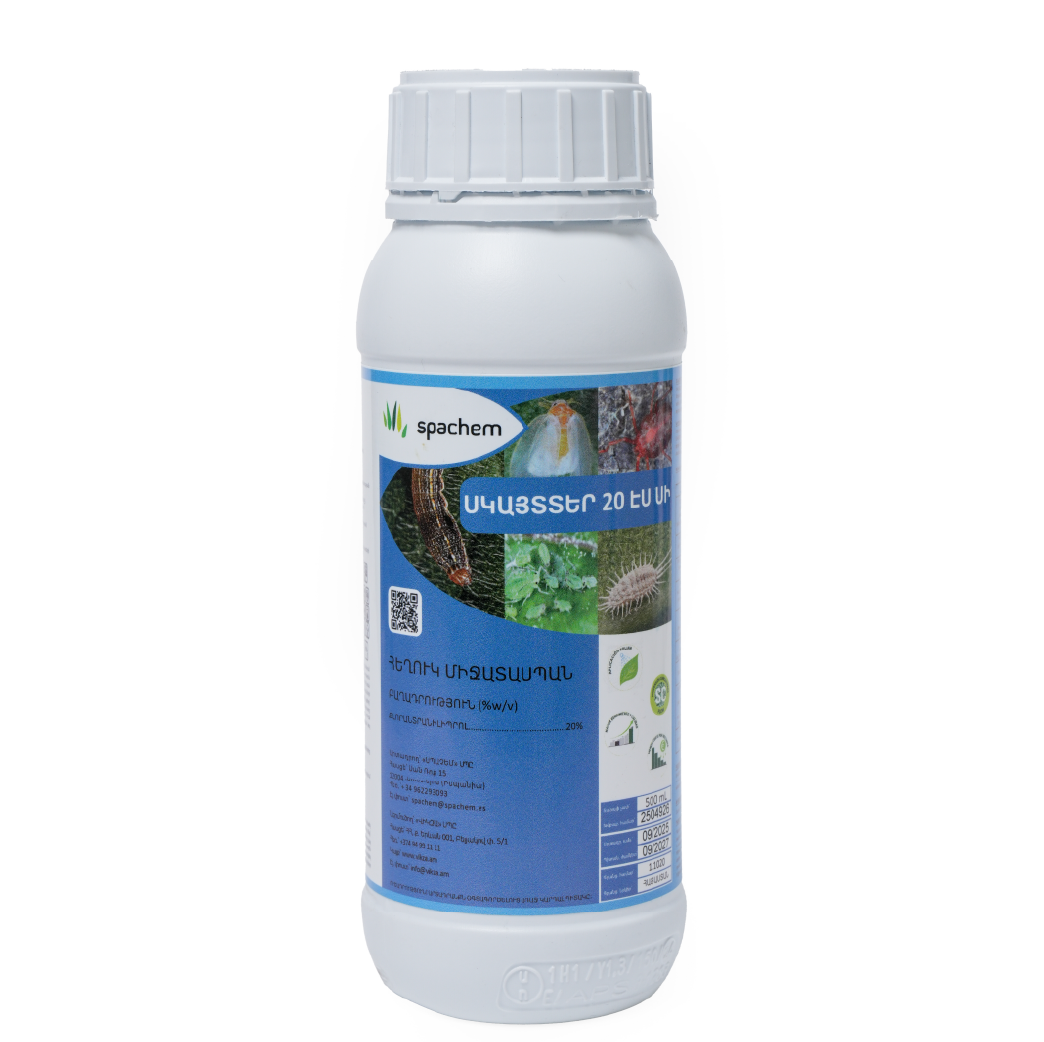
100ml, 250ml, 500ml, 1L, 5L, 10L, 20L, 200L, 1000L




SKYTTER 20 SC is an Insecticide belonging to the group of anthranilic diamides, with activity by ingestion and contact, presented in the form of a concentrated aqueous suspension to be applied as a foliar spray, at the base of the plant or in drip irrigation. Treatments are most effective when scheduled to control eggs or larvae. It has contact activity although it is more effective through ingestion of the treated material.
| CROPS | Pests | DOSE (L/Ha) |
|---|---|---|
| Fruit trees (peach, nectarine, plum, cherry, apricot, kumquat, pear, apple, pomegranate, persimmon, fig etc.) | Minelayer (Liriomyza sativae) |
0.125 |
| Fruit trees (peach, nectarine, plum, cherry, apricot, kumquat, pear, apple, pomegranate, persimmon, fig etc.) | Asian locust (Locusta migratoria) |
0.2 - 0.3 Postembryonic developmental stages |
| Fruit trees (peach, nectarine, plum, cherry, apricot, kumquat, pear, apple, pomegranate, persimmon, fig etc.) | Codling moth (Laspeyresia pomonella) |
0.2 - 0.25 |
| Fruit trees (peach, nectarine, plum, cherry, apricot, kumquat, pear, apple, pomegranate, persimmon, fig etc.) | Plum Fruitworm (Laspeyresia funebrana) |
0.2 - 0.25 |
| Fruit trees (peach, nectarine, plum, cherry, apricot, kumquat, pear, apple, pomegranate, persimmon, fig etc.) | Moth (Spodoptera spp) |
0.1 - 0.2 |
| Fruit trees (peach, nectarine, plum, cherry, apricot, kumquat, pear, apple, pomegranate, persimmon, fig etc.) | Ni moth (Trichoplusia ni) |
0.1 - 0.2 |
| Fruit trees (peach, nectarine, plum, cherry, apricot, kumquat, pear, apple, pomegranate, persimmon, fig etc.) | Butterfly (Diaphania spp) |
0.1 - 0.2 |
| Vegetables (tomato, pepper, chili, eggplant, potato, carrot, zucchini) | Silver Y (Autographa gamma) |
0.2 - 0.25 |
| Vegetables (tomato, pepper, chili, eggplant, potato, carrot, zucchini) | Lined click beetle (Agrotis lineatus) |
0.2 |
| Vegetables (tomato, pepper, chili, eggplant, potato, carrot, zucchini) | Steppe click beetle (Agrotis gurgistanus) |
0.2 |
| Vegetables (tomato, pepper, chili, eggplant, potato, carrot, zucchini) | Minelayer (Liriomyza sativae) |
0.12 - 0.2 |
| Vegetables (tomato, pepper, chili, eggplant, potato, carrot, zucchini) | Asian locust (Locusta migratoria) |
0.2 - 0.3 Postembryonic developmental stages |
| Vegetables (tomato, pepper, chili, eggplant, potato, carrot, zucchini) | Colorado potato beetle (Leptinotarsa decemlineata) |
0.2 - 0.25 |
| Vegetables (tomato, pepper, chili, eggplant, potato, carrot, zucchini) | Tomato leafminer (Tuta absoluta) |
0.2 |
| Vegetables (tomato, pepper, chili, eggplant, potato, carrot, zucchini) | Moth (Spodoptera spp) |
0.2 - 0.4 |
| Vegetables (tomato, pepper, chili, eggplant, potato, carrot, zucchini) | Common click beetle (Agriotes sputator) |
0.2 |
| Vegetables (tomato, pepper, chili, eggplant, potato, carrot, zucchini) | Ni moth (Trichoplusia ni) |
0.2 - 0.4 |
| Vegetables (tomato, pepper, chili, eggplant, potato, carrot, zucchini) | Butterfly (Diaphania spp) |
0.2 - 0.4 |
| Vegetables (tomato, pepper, chili, eggplant, potato, carrot, zucchini) | Moth (Keiferia spp) |
0.2 - 0.4 |
| Vegetables (tomato, pepper, chili, eggplant, potato, carrot, zucchini) | Moths (Heliothis spp) |
0.2 - 0.4 |
| Edible leaf crops (cabbage, lettuce, broccoli, spinach) | Silver Y (Autographa gamma) |
0.2 - 0.25 |
| Edible leaf crops (cabbage, lettuce, broccoli, spinach) | Lined click beetle (Agrotis lineatus) |
0.2 |
| Edible leaf crops (cabbage, lettuce, broccoli, spinach) | Steppe click beetle (Agrotis gurgistanus) |
0.2 |
| Edible leaf crops (cabbage, lettuce, broccoli, spinach) | Minelayer (Liriomyza sativae) |
0.12 - 0.20 |
| Edible leaf crops (cabbage, lettuce, broccoli, spinach) | Asian locust (Locusta migratoria) |
0.2 - 0.3 Postembryonic developmental stages |
| Edible leaf crops (cabbage, lettuce, broccoli, spinach) | Cabbage white (Pieris brassicae) |
0.2 - 0.25 |
| Edible leaf crops (cabbage, lettuce, broccoli, spinach) | Cabbage scoop (Mamestra brassicae) |
0.2 - 0.25 |
| Edible leaf crops (cabbage, lettuce, broccoli, spinach) | Moth (Spodoptera spp) |
0.2 - 0.5 |
| Edible leaf crops (cabbage, lettuce, broccoli, spinach) | Common click beetle (Agriotes sputator) |
0.2 |
| Edible leaf crops (cabbage, lettuce, broccoli, spinach) | Colorado potato beetle (Leptinotarsa decemlineata) |
0.2 - 0.25 |
| Edible leaf crops (cabbage, lettuce, broccoli, spinach) | Ni moth (Trichoplusia ni) |
0.2 - 0.5 |
| Edible leaf crops (cabbage, lettuce, broccoli, spinach) | Butterfly (Diaphania spp) |
0.2 - 0.5 |
| Edible leaf crops (cabbage, lettuce, broccoli, spinach) | Moth (Keiferia spp) |
0.2 - 0.5 |
| Edible leaf crops (cabbage, lettuce, broccoli, spinach) | Moths (Heliothis spp) |
0.2 - 0.5 |
| Liliaceas and other crucifera (garlic, onion, asparagus, turnip, radishes) | Silver Y (Autographa gamma) |
0.2 - 0.25 |
| Liliaceas and other crucifera (garlic, onion, asparagus, turnip, radishes) | Lined click beetle (Agrotis lineatus) |
0.2 |
| Liliaceas and other crucifera (garlic, onion, asparagus, turnip, radishes) | Steppe click beetle (Agrotis gurgistanus) |
0.2 |
| Liliaceas and other crucifera (garlic, onion, asparagus, turnip, radishes) | Minelayer (Liriomyza sativae) |
0.12 - 0.20 |
| Liliaceas and other crucifera (garlic, onion, asparagus, turnip, radishes) | Asian locust (Locusta migratoria) |
0.2 - 0.3 Postembryonic developmental stages |
| Liliaceas and other crucifera (garlic, onion, asparagus, turnip, radishes) | Onion fly (Hylemya antiqua) |
0.2 - 0.3 |
| Liliaceas and other crucifera (garlic, onion, asparagus, turnip, radishes) | Onion fly (Hylemya antiqua) |
0.2 - 0.3 |
| Liliaceas and other crucifera (garlic, onion, asparagus, turnip, radishes) | Turnip moth (Agrotis segetum) |
0.2 - 0.25 |
| Liliaceas and other crucifera (garlic, onion, asparagus, turnip, radishes) | Moth (Spodoptera spp) |
0.2 - 0.5 |
| Liliaceas and other crucifera (garlic, onion, asparagus, turnip, radishes) | Common click beetle (Agriotes sputator) |
0.2 |
| Liliaceas and other crucifera (garlic, onion, asparagus, turnip, radishes) | Ni moth (Trichoplusia ni) |
0.2 - 0.5 |
| Liliaceas and other crucifera (garlic, onion, asparagus, turnip, radishes) | Butterfly (Diaphania spp) |
0.2 - 0.5 |
| Liliaceas and other crucifera (garlic, onion, asparagus, turnip, radishes) | Moth (Keiferia spp) |
0.2 - 0.5 |
| Liliaceas and other crucifera (garlic, onion, asparagus, turnip, radishes) | Moths (Heliothis spp) |
0.2 - 0.5 |
| Extensive and industrial (wheat, corn, barley, tabaci, beet) | Silver Y (Autographa gamma) |
0.2 - 0.25 |
| Extensive and industrial (wheat, corn, barley, tabaci, beet) | Lined click beetle (Agrotis lineatus) |
0.2 |
| Extensive and industrial (wheat, corn, barley, tabaci, beet) | Steppe click beetle (Agrotis gurgistanus) |
0.2 |
| Extensive and industrial (wheat, corn, barley, tabaci, beet) | Stem borers (Barrenadore (Chilo spp)) |
0.06 - 0.075 |
| Extensive and industrial (wheat, corn, barley, tabaci, beet) | Asian locust (Locusta migratoria) |
0.2 - 0.3 Postembryonic developmental stages |
| Extensive and industrial (wheat, corn, barley, tabaci, beet) | Colorado potato beetle (Leptinotarsa decemlineata) |
0.2 - 0.25 |
| Extensive and industrial (wheat, corn, barley, tabaci, beet) | Wheat Grain Beetle (Anisoplia austriaca) |
0.2 - 0.3 |
| Extensive and industrial (wheat, corn, barley, tabaci, beet) | Shining leaf chafer (Anisoplia agricola) |
0.2 - 0.3 |
| Extensive and industrial (wheat, corn, barley, tabaci, beet) | Corn Flea beetle (Chaetocnema hortensis) |
0.2 - 0.3 |
| Extensive and industrial (wheat, corn, barley, tabaci, beet) | Sunn pest (Eurygaster integriceps) |
0.2 - 0.3 |
| Extensive and industrial (wheat, corn, barley, tabaci, beet) | Wheat thrips (Haplothrips tritici) |
0.2 - 0.3 |
| Extensive and industrial (wheat, corn, barley, tabaci, beet) | Moth (Spodoptera spp) |
0.075 - 0.10 |
| Extensive and industrial (wheat, corn, barley, tabaci, beet) | Common click beetle (Agriotes sputator) |
0.2 |
| Extensive and industrial (wheat, corn, barley, tabaci, beet) | Ni moth (Trichoplusia ni) |
0.075 - 0.10 |
| Extensive and industrial (wheat, corn, barley, tabaci, beet) | Butterfly (Diaphania spp) |
0.075 - 0.10 |
| Extensive and industrial (wheat, corn, barley, tabaci, beet) | Moth (Keiferia spp) |
0.075 - 0.10 |
| Extensive and industrial (wheat, corn, barley, tabaci, beet) | Moths (Heliothis spp) |
0.075 - 0.10 |
| Berries (strawberry, raspberry, blueberry, blackberries, currant, vine) | Silver Y (Autographa gamma) |
0.2 - 0.25 |
| Berries (strawberry, raspberry, blueberry, blackberries, currant, vine) | Lined click beetle (Agrotis lineatus) |
0.2 |
| Berries (strawberry, raspberry, blueberry, blackberries, currant, vine) | Steppe click beetle (Agrotis gurgistanus) |
0.2 |
| Berries (strawberry, raspberry, blueberry, blackberries, currant, vine) | Minelayer (Liriomyza sativae) |
0.05 - 0.1 |
| Berries (strawberry, raspberry, blueberry, blackberries, currant, vine) | Asian locust (Locusta migratoria) |
0.2 - 0.3 Postembryonic developmental stages |
| Berries (strawberry, raspberry, blueberry, blackberries, currant, vine) | European grapevine moth (Polychrosis botrana) |
0.2 - 0.25 |
| Berries (strawberry, raspberry, blueberry, blackberries, currant, vine) | Moth (Spodoptera spp) |
0.05 - 0.1 |
| Berries (strawberry, raspberry, blueberry, blackberries, currant, vine) | Common click beetle (Agriotes sputator) |
0.2 |
| Berries (strawberry, raspberry, blueberry, blackberries, currant, vine) | Ni moth (Trichoplusia ni) |
0.05 - 0.1 |
| Berries (strawberry, raspberry, blueberry, blackberries, currant, vine) | Butterfly (Diaphania spp) |
0.05 - 0.1 |
| Berries (strawberry, raspberry, blueberry, blackberries, currant, vine) | Moth (Keiferia spp) |
0.05 - 0.1 |
| Berries (strawberry, raspberry, blueberry, blackberries, currant, vine) | Moths (Heliothis spp) |
0.05 - 0.1 |
| Cucurbitaceas (melon, watermelon, pumpkin) | Asian locust (Locusta migratoria) |
0.2 - 0.3 Postembryonic developmental stages |
| Cucurbitaceas (melon, watermelon, pumpkin) | Silver Y (Autographa gamma) |
0.2 - 0.25 |
| Cucurbitaceas (melon, watermelon, pumpkin) | Lined click beetle (Agrotis lineatus) |
0.2 |
| Cucurbitaceas (melon, watermelon, pumpkin) | Steppe click beetle (Agrotis gurgistanus) |
0.2 |
| Cucurbitaceas (melon, watermelon, pumpkin) | Minelayer (Liriomyza sativae) |
0.125 |
| Cucurbitaceas (melon, watermelon, pumpkin) | Melon fly (Myiopardalis pardalina) |
0.2 - 0.3 |
| Cucurbitaceas (melon, watermelon, pumpkin) | Moth (Spodoptera spp) |
0.075 - 0.125 |
| Cucurbitaceas (melon, watermelon, pumpkin) | Common click beetle (Agriotes sputator) |
0.2 |
| Cucurbitaceas (melon, watermelon, pumpkin) | Ni moth (Trichoplusia ni) |
0.075 - 0.125 |
| Cucurbitaceas (melon, watermelon, pumpkin) | Butterfly (Diaphania spp) |
0.075 - 0.125 |
| Cucurbitaceas (melon, watermelon, pumpkin) | Moth (Keiferia spp) |
0.075 - 0.125 |
| Cucurbitaceas (melon, watermelon, pumpkin) | Moths (Heliothis spp) |
0.075 - 0.125 |
| Aromatic and ornamental (cilantro, parsley, mint, sage, rosemary, thyme, tarragon, rose, gerberas, thuja, fir tree, carnations) | Asian locust (Locusta migratoria) |
0.2 - 0.3 Postembryonic developmental stages |
| Aromatic and ornamental (cilantro, parsley, mint, sage, rosemary, thyme, tarragon, rose, gerberas, thuja, fir tree, carnations) | Silver Y (Autographa gamma) |
0.2 - 0.25 |
| Aromatic and ornamental (cilantro, parsley, mint, sage, rosemary, thyme, tarragon, rose, gerberas, thuja, fir tree, carnations) | Lined click beetle (Agrotis lineatus) |
0.2 |
| Aromatic and ornamental (cilantro, parsley, mint, sage, rosemary, thyme, tarragon, rose, gerberas, thuja, fir tree, carnations) | Steppe click beetle (Agrotis gurgistanus) |
0.2 |
| Aromatic and ornamental (cilantro, parsley, mint, sage, rosemary, thyme, tarragon, rose, gerberas, thuja, fir tree, carnations) | Minelayer (Liriomyza sativae) |
0.125 |
| Aromatic and ornamental (cilantro, parsley, mint, sage, rosemary, thyme, tarragon, rose, gerberas, thuja, fir tree, carnations) | Turnip moth (Agrotis segetum) |
0.2 - 0.25 |
| Aromatic and ornamental (cilantro, parsley, mint, sage, rosemary, thyme, tarragon, rose, gerberas, thuja, fir tree, carnations) | Moth (Spodoptera spp) |
0.075 - 0.125 |
| Aromatic and ornamental (cilantro, parsley, mint, sage, rosemary, thyme, tarragon, rose, gerberas, thuja, fir tree, carnations) | Common click beetle (Agriotes sputator) |
0.2 |
| Aromatic and ornamental (cilantro, parsley, mint, sage, rosemary, thyme, tarragon, rose, gerberas, thuja, fir tree, carnations) | Ni moth (Trichoplusia ni) |
0.075 - 0.125 |
| Aromatic and ornamental (cilantro, parsley, mint, sage, rosemary, thyme, tarragon, rose, gerberas, thuja, fir tree, carnations) | Butterfly (Diaphania spp) |
0.075 - 0.125 |
| Aromatic and ornamental (cilantro, parsley, mint, sage, rosemary, thyme, tarragon, rose, gerberas, thuja, fir tree, carnations) | 0.075 - 0.125 | |
| Aromatic and ornamental (cilantro, parsley, mint, sage, rosemary, thyme, tarragon, rose, gerberas, thuja, fir tree, carnations) | Moths (Heliothis spp) |
0.075 - 0.125 |
| Legumes (beans, peas, lentils) | Asian locust (Locusta migratoria) |
0.2 - 0.3 Postembryonic developmental stages |
| Legumes (beans, peas, lentils) | Silver Y (Autographa gamma) |
0.2 - 0.25 |
| Legumes (beans, peas, lentils) | Lined click beetle (Agrotis lineatus) |
0.2 |
| Legumes (beans, peas, lentils) | Steppe click beetle (Agrotis gurgistanus) |
0.2 |
| Legumes (beans, peas, lentils) | Minelayer (Liriomyza sativae) |
0.125 |
| Legumes (beans, peas, lentils) | Bean weevil (Acanthoscelides obtectus) |
0.2 - 0.3 |
| Legumes (beans, peas, lentils) | Pea moth (Laspeyresia nigricana) |
0.2 - 0.25 |
| Legumes (beans, peas, lentils) | Moth (Spodoptera spp) |
0.075 - 0.125 |
| Legumes (beans, peas, lentils) | Common click beetle (Agriotes sputator) |
0.2 |
| Legumes (beans, peas, lentils) | Alfalfa Weevil or Phytonomus (Phytonomus variabilis) |
0.2 - 0.3 |
| Legumes (beans, peas, lentils) | Alfalfa seed-eater (Tychius flavus) |
0.2 - 0.3 |
| Legumes (beans, peas, lentils) | Ni moth (Trichoplusia ni) |
0.075 - 0.125 |
| Legumes (beans, peas, lentils) | Butterfly (Diaphania spp) |
0.075 - 0.125 |
| Legumes (beans, peas, lentils) | Moth (Keiferia spp) |
0.075 - 0.125 |
| Legumes (beans, peas, lentils) | Moths (Heliothis spp) |
0.075 - 0.125 |
Skytter 20 SC
SKYTTER 20 SC is an Insecticide belonging to the group of anthranilic diamides, with activity by ingestion and contact, presented in the form of a concentrated aqueous suspension to be applied as a foliar spray, at the base of the plant or in drip irrigation. Treatments are most effective when scheduled to control eggs or larvae. It has contact activity although it is more effective through ingestion of the treated material.
- Chlorantraniliprole 20.0 %
SKYTTER 20 SC is an insecticide that penetrates the tissue of the leaves and acts especially by ingestion of the treated parts of the plants, although it also has contact activity. Furthermore, it is mobilized by xylem and has a translaminar action, translocating to other parts of the untreated plant. Chlorantraniliprole exerts its toxic action by activating ryanodine receptors, which involves the uncontrolled release of calcium ions from the internal reservoirs of the sarcoplasmic reticulum in muscle cells. This leads to immediate cessation of feeding, lethargy, paralysis from muscle contraction, and death of the insects from starvation within 1 to 3 days.
RECOMMENDATIONS FOR USEMAXIMUM NUMBER OF TREATMENTS
Make a one application per campaign, considering 2 campaigns per year.
Regulate the pH.
The effectivenes of treatments are provided by a complete follage wettiness and use of adjuvant.
INTERVAL BETWEEN LAST APPLICATION AND HARVEST (WAITING PERIOD)
4 h․
RE-ENTRY INTERVAL TO THE TREATED AREA
Wait 4 hours. If it is necessary to enter before this period, full protective equipment must be used.
RESISTANCE MANAGEMENT
Management of resistance: To avoid the appearance of resistance, do not use this product or any other product containing Chlorantraniliprole more than 2 applications per campaign.
SKYTTER 20 SC is compatible with the products usually used in these crops.
SKYTTER 20 SC does not present known incompatibilities with other commonly used pesticides. Since formulations may change and new ones be introduced, it is recommended that users premix in small quantities and observe negative effects (such as flocculation, precipitation.
It is not phytotoxic when used according to the recommendations and doses of SPACHEM S.L. In case of mixing, perform a small scale test to check compatibility and phytotoxicity.
REMARKS
The recommendations and information we provide are the result of extensive and rigorous studies and tests, however, numerous factors beyond our control may intervene in the use (preparation of mixtures, application, weather, etc.). The company guarantees the composition, formulation and content. The user will be liable for any damage caused ( lack of efficacy, general toxicity, residues, etc.) due to total or partial non-observance of the label instructions.
- Verify the correct calibration of the equipment before starting the application
- Put water halfway up the tank of the applicator equipment, add the necessary amount of SKYTTER 20 SC product according to the dose recommended on this label, keeping the shaker running and top up with the rest of the volume of water.
- It is recommended to add a non-ionic adjuvant to improve coverage.
- Before starting any treatment, it is essential to verify the correct calibration of the equipment and the proper functioning of the nozzles (filters and pads), replacing the defective parts.
- Do not perform applications with high temperatures.
- Apply away from springs, courses, or fountains.
- Always calibrate your equipment with water only before applying the product.
- Remember to get the right auxiliary equipment (solid and liquid product meters), graduated trays, stirring paddles, brushes, brushes, etc.
- Use the following protective equipment for mixing, loading, and applying: boots, mask, goggles, gloves, and dispenser.
The icon refers to a suspension concentrate (SC). This is a liquid formulation containing a solid, insoluble active ingredient dispersed in water as very fine particles less than 10 microns. It is diluted in water for application, offering advantages such as easy handling, reduced dust, high efficacy, and good dispersion in water.
The icon highlights fertilizers with high agronomic and economic efficiency.
The icon communicates that the product is formulated to maximize productivity and improve the commercial quality of the crop.
The icon identifies products designed for direct application to leaves, where nutrients and biostimulants are rapidly absorbed through the stomatal and cuticular pathways.